I said earlier that I would look at the Wikipedia article on William of Ockham*. This followed James Hannam's article in the Spectator deploring the fact that "the entry on Alhazen is 7,000 words long and bristles with 126 footnotes. Major figures of the medieval Christian world such as Ockham receive only 2,500 words". I commented that as well as being short, the article on Ockham was 'grossly misleading and incorrect'. How misleading? How inaccurate?
Life
The article begins with the observation that Ockham was born in Yorkshire and not, as most standard reference works suppose, in the village of Ockham in Surrey. This curiosity was inserted by an IP address on 3 May 2010. The philosopher C. Delisle Burns proposed this in 1916, but I can find no modern reference work that says this. Some sources say that he actually came from Woking, which had a similar spelling in medieval times, but Wikipedia does not mention this at all.
The rest of Ockham's biography is not so bad. It mentions the usual things about being summoned to Avignon, the controversy among the Franciscans, leaving Avignon in 1328 for exile at the court of Louis IV. Biographies in Wikipedia are generally accurate and well-written, mainly because, I suspect, there is no difficulty about which order to set out the facts. You start with a birth, and end with a death, and there is stuff in between.
Philosophical Thought
When we turn to the work of a great person, it is much more difficult, because this requires understanding the work, and making a judgment about which parts of the work to emphasis and explain. This is particularly important with medieval philosophers because, mostly, we have very little information about their lives. We have an intimate and deep knowledge of what they thought, because we have their work. But this requires understanding their work, and so we turn to the work of Ockham according to Wikipedia.
The odd section on his philosophical thought begins "In scholasticism, Okham advocated a reform both in method and in content, the aim of which was simplification" which is straightforwardly lifted out of the Catholic Encyclopedia, and which illustrates an important principle of Wikipedia (and much of the Internet) that essays about more serious subjects (i.e. subjects unconnected with Pokemon, Star Trek episodes and 'porn star' biographies) are taken from out of copyright sources like the Catholic Encyclopedia, or the 1911 Britannica. The irony that an ultra modern high-tech medium like the Internet, when it reflects anything of importance, reflects the sometimes obsolete views of 19th century scholars.
Nominalism
The section on nominalism is mostly lifted from the Catholic Encyclopedia, except for the paragraph at the end, where the abrupt change in style signals an entirely plagiarised excerpt from the Stanford Encyclopedia of Philosophy. The strange claim that Ockham has been called a "terminist", to distinguish him from a nominalist or a conceptualist, is from the Catholic Encyclopedia. Thus the article combines what is probably wrong ('terminism' can be consistent with nominalism**) with the section from the SEP which is intended for an academic audience, and is impenetrable out of context.
Natural Philosophy
The whole section on Natural Philosophy is eccentric and strange, with a convoluted discussion of impetus theory, of the views of Mach and Whitehead, and of "the president of the Birmingham Scientific Society, George Gore". This section was added on 7 June 2007 by an editor who was later banned for promoting strange and eccentric views on the history of science. You can read the discussion here. It illustrates an important principle of Wikipedia, namely that many editors are like this, and eventually end up banned. Their reason for editing Wikipedia is to promote some pet theory that they could not get published in an academic journal, but will always be accepted by 'the encyclopedia that anyone can edit'.
Ontological parsimony
The next section also mixes up passages from the Catholic Encyclopedia and the SEP, in a way that is highly misleading. It says that 'Ockham's Razor' is formulated by him as “For nothing ought to be posited without a reason given, unless it is self-evident (literally, known through itself) or known by experience or proved by the authority of Sacred Scripture.” The sentence is lifted verbatim from the SEP, except the SEP does not claim it is a formulation of the principle. Rather it suggests it is a sort of exception to the principle.
The original version of the article also copied the SEP claim that Ockham does not accept the Principle of Sufficient Reason. In a strange edit here made in 2006, an editor changes this to 'accepts' the principle. This is the same editor who added the plagiarised sections from the Catholic Encyclopedia, and whose contribution history suggests many such insertions, including a whole article about the late Scholastic philosopher Zabarella. Note that Wikipedia now contradicts itself, for the article on Ockham's Razor still retains the claim that Ockham did not accept the Principle of Sufficient Reason.
Theory of knowledge
The section on Ockham's theory of knowledge is clearly not plagiarised; the style is too amateurish and clumsy. As Dr Johnson once quipped: "Your work is both good and original. Unfortunately the parts which are good are not original, and the parts which are original are not good". (Or something like that).
Political Theory
The section on his political is reasonably written and seems reasonably accurate (although I am not an expert on this aspect of Ockham). It is however very brief, given the importance which experts attach to his work. if he really was one of the first medieval authors to advocate a form of separation between church and state, why does Wikipedia devote far less space (one sentence) than it does to the biography of a porn star?
Logic
The section on Ockham's logic is also remarkable for its brevity, considering that Ockham's fame rests mostly on his logical work, the magisterial and compendious Summa Logicae. It mentions only Ockham's anticipation of De Morgan's laws, and of many-valued logic. The latter claim is completely misleading. It illustrates the tendency of all reference work to emphasise the ideas of thinkers which anticipate, or seem to anticipate, later developments in philosophy and science, at the expense of other interesting ideas they may have had. No source is given; it probably comes from Ockham's defence of the 'traditional' interpretation of Aristotle (in Exposition in Librum Perihermenias I.6.15 - see the SEP article here). But it fails to mention that nearly all commentators on the famous 'sea battle' problem discussed by Aristotle were exercised by the problem of statements about future events, and by the possibility that such statements are neither true nor false. Thus the idea of a third 'truth value' did not originate with Ockham, and may have originated with Aristotle, depending on how you interpret Aristotle.
There is no discussion at all of how Ockham's nominalism is connected with his logic, of his use of supposition theory, nor of the way that Ockham really does anticipate the ideas of modern analytic philosophy in his view that you can address 'metaphysical' problems by carving up a sentence in the right way.
In summary: the Wikipedia article on William of Ockham, one of England's most illustrious and important philosophers, is woefully incomplete and inaccurate. It mixes blatant plagiarism with blatant falsehood. This is not surprising. What is surprising is the way that the respectable press eulogises Wikipedia, respectable institutions like the British Museum are entering into partnership with it, respectable donors like the Sloan Foundation are contributing large sums of money to it. This needs to change, although it is hard to see how.
* Permalink: version of 24 June 2010.
** Particularly in the case of Ockham's nominalism, defined as the view that we should not multiply entities according to the multiplicity of names.
Showing posts sorted by relevance for query plagiarised. Sort by date Show all posts
Showing posts sorted by relevance for query plagiarised. Sort by date Show all posts
Wednesday, June 23, 2010

Sunday, November 07, 2010
Plagiarism now and then
I've commented before that many of Wikipedia's articles are plagiarised from out of date sourceslike the Catholic Encyclopedia and Encyclopedia Britannica. Actually a lot of them are plagiarised from more current sources. The table below compares the article on an American Buddhist temple written by a member of the prestigious Arbitration committee with the source where he apparently obtained it from. He has since left ‘the project’ after similar concerns raised by other users, and left this touching message on his talk page. This includes the bizarre statement “I asked many people for help because I know I’m not good at writing”.
| Wikipedia | HISTORY OF WAT PASANTIDHAMMA |
|---|---|
| The first formal meeting was held on August 25, 1996 in York County, Virginia and was attended by many local Thais, Laotians, and Cambodians. | The first formal meeting was held on August 25, 1996at the Thai Erawan Restaurant in York County, Virginia. The meeting was very successful with many local Thais, Laotians, Cambodians attended. |
| After the meeting, the first newsletter was published and distributed. | After the meeting, the first newsletter was published and distributed. |
| PhraMaha Surasak Jivanando, the Abbot of Wat Thai Washington, D.C., provided advice to the group throughout the process to get the new temple functioning. | PhraMaha Surasak Jivanando, the Abbot of Wat Thai Washington, D.C., who is widely known for his wisdom, kindness, and well respected, provides unending support and advice to the group. |
| On September 8, 1996, members of the Thai Buddhist community went to Wat Thai and had the first formal meeting with PhraMaha Surasak. | Seeking his advice, on September81996, members of the Samukee Group went to Wat Thai Washington, D.C. and had the first formal meeting with PhraMaha Surasak again on November 19, 1996. |
| The association's first formal president, Dr. Tawatchai Onsanit, guided the organization through the first two years. | The association first formal president, Dr. Tawatchai Onsanit, guided the organization through trouble water during the first two years. |
| Rental properties for religious functions were scarce and thus the association looked for a property to buy. | It was also obvious that the rental property for religious functions were scarce. Consequently, probability of succeeding with purchase option was far greater. |
| The first priority was to have a place where one or two monks could reside in the Tidewater area and provide continuous spiritual leadership. The search committee finally found an affordable place in Carrolton, Isle of Wight County, Virginia.[1] | … the first priority was to have a monks' residence such that one or two monks could reside in the Tide Water area and could provide continuous spiritual leadership. The search committee finally found an affordable place at 14289 Chapman's Lane in Carrolton, Isle of Wight County, Virginia. |
| On September 28, 1997, PhraMaha Taweepong Tawiwongso, PhraMaha Putthachak Buddhisaro, and PhraMaha Saman Methawee were invited to a local celebration of the "Sarth Thai" Day and to visit the place of interest. All monks agreed that was a perfect place for a monks' residence and a meditation center as it was rural and located in a wooded setting. | On September 28, 1997, PhraMaha Taweepong Tawiwongso, PhraMahaPutthachak Buddhisaro, and PhraMahaSaman Methawee were invited to a local celebration of the "Sarth Thai"Day and to visit the place of interest. All of the monks agreed that was a perfect place for a monks' residence and a meditation center. |
| Upon consensus among its members, the Association presented to PhraMaha Surasak Jivanando a proposal to formally establish a monks' residence and requested that two monks reside at the place and act as local religious leaders. | Upon consensus of the its members, the Association presented to PhraMaha Surasak Jivanando a proposal to formally establishing a monks' residence and requested that two monks are to reside at the place and to be local religious leaders. |
| On December 31, 1997, The Buddha Samukee Association bought the said parcel on Chapman's Lane for the sum of 50,000 dollars with the owner agreeing to hold a $40,000 mortgage note. The parcel consists of 6.35 acres of wooded land and a house. | On December 31, 1997, The Buddha Samukee Associationbought the said parcel on Chapman's Lane for the sum of 50,000 dollars with the owner agreed to hold a $40,000 mortgage note. The parcel consists of 6.35 acres of wooded land and a house. |
| In January 1998, Phra Maha Surasak and other monks from Wat Thai Washington D.C. graciously accepted the invitation to visit the place and to give a blessing and a name of 'Wat Pa Santidhamma'.[1] | On January 1998, Phra Maha Surasak and other monks from Wat Thai Washington D.C. were graciously accepted the invitation to visit the place and to give a blessing and a name of 'Wat Pa Santidhamma' |
Friday, May 27, 2011
Can crowdsourcing make all articles excellent?
Ex-climate scientist William Connolley questions the logic of an earlier post, saying that
On the other possible claims that William mentions, I disagree that "crowdsourcing makes all wikipedia articles excellent" is trivially false. Since we agree it is false, it follows that crowdsourcing fails to make certain articles excellent, and it is an interesting, and therefore non-trivial, question whether there are certain types of article, or certain types of information that crowdsourcing fails to make excellent, and if so why.
I don't propose to answer these non-trivial questions here - I merely point out that they are obviously non-trivial. I have made suggestions in the past. I suggested that "crowdsourcers are typically shy of deleting material, so articles tend to grow to the point of being unreadable. Second, they have no sense of where material ought to go. So the article tends to lose any basic thread it once had. Third, they have no sense of which facts to include, and which to leave out. What facts about Aristotle would you include in a three page article?". I have also observed that, as a general rules, Wikipedia's coverage of subjects like Boron and set theory is pretty good. On the arts and humanities it is a complete disaster. As Vaknin says, "they are replete with nonsense, plagiarism, falsities, and propaganda".
So it's an interesting question as to whether the poor quality of arts subjects is simply a matter of accident, and could have been the other way round. Another interesting (and therefore non-trivial) question is whether crowdsourcing is better at 'low culture' than 'high culture'. My view is that it is pretty good at articles like this, but really dreadful at articles like this. More later.
I'm not really sure exactly what claim about crowdsourcing you are calling false. If the claim is, crowdsourcing makes all wikipedia articles excellent, then it is trivially false. If the claim is, crowdsourcing is capable of creating excellent articles, then it is trivially true. Probably you mean something else, but what?Well, as to exactly what claim of crowdsourcing I was originally calling false, in this post I cited the articles on Durandus and Roscellinus as evidence against the claim that crowdsourcing makes Wikipedia "instantly responsive to new developments". The fact that these articles are entirely plagiarised or 'copied' from the 1913 Catholic Enyclopedia and Britannica 1911 suggests that Wikipedia is somewhat sluggish on the 'new development' front.
On the other possible claims that William mentions, I disagree that "crowdsourcing makes all wikipedia articles excellent" is trivially false. Since we agree it is false, it follows that crowdsourcing fails to make certain articles excellent, and it is an interesting, and therefore non-trivial, question whether there are certain types of article, or certain types of information that crowdsourcing fails to make excellent, and if so why.
I don't propose to answer these non-trivial questions here - I merely point out that they are obviously non-trivial. I have made suggestions in the past. I suggested that "crowdsourcers are typically shy of deleting material, so articles tend to grow to the point of being unreadable. Second, they have no sense of where material ought to go. So the article tends to lose any basic thread it once had. Third, they have no sense of which facts to include, and which to leave out. What facts about Aristotle would you include in a three page article?". I have also observed that, as a general rules, Wikipedia's coverage of subjects like Boron and set theory is pretty good. On the arts and humanities it is a complete disaster. As Vaknin says, "they are replete with nonsense, plagiarism, falsities, and propaganda".
So it's an interesting question as to whether the poor quality of arts subjects is simply a matter of accident, and could have been the other way round. Another interesting (and therefore non-trivial) question is whether crowdsourcing is better at 'low culture' than 'high culture'. My view is that it is pretty good at articles like this, but really dreadful at articles like this. More later.
Thursday, May 26, 2011
The Logic Museum is excommunicated
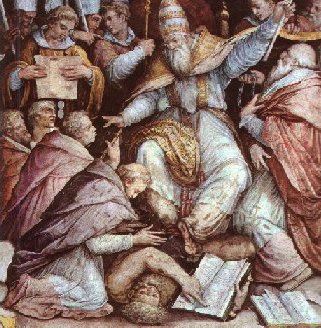 Today is May 26, the anniversary of my namesake William of Ockham's flight from Avignon after a dispute with the Pope about Franciscan poverty. That strangely coincides with two other related things.
 First, the excommunication of my website The Logic Museum from Wikipedia. This means that any mention of the Museum, or any outbound link to it from Wikipedia, is now prohibited. As my readers will know, the Museum is primarily a repository of primary sources on logic, mainly medieval texts, that are difficult to locate even in a good university library (some of the texts I plan on publishing are unavailable even in London). What did the poor creature do to deserve this? (I am told it is because of my criticism of Wikipedia here, and because of other criticism by the owner of the hosting site, Greg Kohs).
Second, Ockham's flight is mentioned on the main page of Wikipedia - see the in the 'on this day' column. "On this day ... 1328 – William of Ockham, originator of the methodological principle Occam's razor, secretly left Avignon under threat from Pope John XXII". This is ironic. As every medieval scholar knows, Ockham was not the originator of this principle at all (although he often used it, and it bears his name). If they had been allowed to link to the Logic Museum, Wikipedians would have learned this. They could have looked at this essay by Thorburn, who first debunked the claim nearly 100 years ago. Or they could look in the article on Ockham in the Logic Museum. But they can't.
And as I commented last year, there are many mistakes in the article itself. Some were cleaned up (by someone I notified by email). But, as of this morning, many errors or significant omissions remain.
- The most significant error in the article still remained until this morning (when someone spotted a draft of this post and changed it. It said that Ockham does accept the Principle of Sufficient Reason, when of course he clearly doesn't. Until this morning, that mistake was there for five years. And there is still a problem, because the claim is spliced with an unrelated one sourced from the Catholic Encyclopedia, about Ockham's view on the distinction between essence and existence, between the active and passive intellect.
- It stills contains the odd claim that Ockham has been called a "terminist", to distinguish him from a nominalist or a conceptualist, is from the Catholic Encyclopedia. Thus the article combines what is probably wrong ('terminism' can be consistent with nominalism**) with the section from the SEP which is intended for an academic audience, and is impenetrable out of context.
- As I commented just this week, the article on Durandus does not mention that Durandus was one of those assigned by John XXII to investigate Ockham’s nominalism. That is because the whole article was plagiarised from the Catholic Encyclopedia, written 100 years ago. Nor does the article on Ockham.
If you feel strongly about this, and I think you should, you can comment on Jimmy Wales page here.
** Particularly in the case of Ockham's nominalism, defined as the view that we should not multiply entities according to the multiplicity of names.
Thursday, May 19, 2011
Web 2.0 Nonsense on Stilts
Here. Nonsense on stilts. Every cliche or stereotype of 'Web 2.0', and Wikipedia as well. It begins with the (desperately flawed) study in Nature which supposedly showed "few differences in accuracy" between Wikipedia and the Encyclopedia Britannica, comments approvingly on the "bogglingly complex and well-staffed system for dealing with errors and disputes on Wikipedia", without mentioning about how astonishingly corrupt this system is. It argues that there are three main advantages to Wikipedia:
- Wikipedia offers far richer, more comprehensive citations to source materials and bibliographies on- and offline, thereby providing a far better entry point for serious study (yes, but many of these 'citations' are completely fake, as was proved in this case, and many others are simply cherry-picked).
- It is instantly responsive to new developments (and yet articles like Durandus or Roscellinus are entirely plagiarised from the century old Catholic Enyclopedia and Britannica 1911)
- It has 'history' and 'talk' pages (of course, but as the article immediately concedes "a load of dimwitted yelling and general codswallop may also emerge", and usually does).
The computer thus holds out the promise of a technologically engendered state of universal understanding and unity, a state of absorption in the Logos that could knit mankind into one family and create a perpetuity of harmony and peace.And so Wikipedia, along with other "crowd-sourced" resources, is wreaking a certain amount of McLuhanesque havoc on conventional notions of "authority," "authorship," and even "knowledge." We have reached 'the end of truth'
Wikipedia is like a laboratory for this new way of public reasoning for the purpose of understanding, an extended polylogue embracing every reader in an ever-larger, never-ending dialectic. Rather than being handed an "authoritative" decision, you're given the means for rolling your own.Fortunately the commenters were somewhat better informed than the author of this silly and foolish article. One of them writes
This article is foolish and actually mischaracterizes what Wikipedia is doing. Wikipedia is based around a strong hierarchy between experts and everyone else. Credentialed experts do primary research. They look at the actual stuff. Wiki-editors do secondary research. They read the sources that the experts write and debate the meaning of those sources. This is the governance that is built into the site, and it is a hierarchical one. Wiki-editors would only be “fellow travelers” with experts if they did primary research themselves. But how many times have you seen wiki-editors cite their own research in French or Russian archives, or their own experiments on bacteria, or their own mathematical proofs? Never. And that’s the difference.Correct. Not that even this works, in many cases, but I have discussed all that elsewhere.
Wikipedia hardly devalues experts. It enshrines them like never before. Every statement in a Wikipedia article has to be backed up with a citation to an article or book produced by a journalist, an academic, a scientist, or some other credentialed expert who has carried out primary research according to currently prevailing methods in journalism or academia. In no way are the wiki-writers “fellow travelers” with these expert sources in the governance of the site. Their job is only to debate which wording best characterizes the existing expert sources for the purposes of an encyclopedia article. This is all great as a learning exercise, and I applaud them for doing so, but it does not equalize experts and readers.
Saturday, October 16, 2010
Andronicus of Rhodes
A remark by Boethius about Andronicus of Rhodes took me on a search for the man. As usual, Wikipedia came up. I was struck again, as so many times before, by Wikipedia's reliance on old out-of-copyright material mostly from the late nineteenth and early twentieth century, and by the ironic contrast between the advanced technology which led to the birth of the "Web 2.0" project, and the sort of material that ends in it - informative and interesting but essentially obsolete scholarship from more than a hundred years ago.
I have compiled a table below showing how the Wikipedia article on Andronicus was entirely plagiarised from two sources. Most of it is from William Smith's Dictionary of Greek and Roman Biography and Mythology, with the exception of two short passages taken verbatim from the 1911 Encyclopedia Britannica article about him (in bold). The only difference is the part at the end which was omitted from Wikipedia (presumably because too dull or serious).
There is now much better scholarship available about Andronicus. The Stanford Encyclopedia of Philosophy article is a good start. But the SEP project involves professional philosophers who are rewarded for their contribution by having their name against the article, and by the guarantee of protection against vandalism of the 'anyone can edit' sort. Interesting as the project is, I don't think we will ever see anything of real value from Wikipedia.
If Wikipedia is around in 100 years time, will the historical information in it still be 100 years out of date? But then which encyclopedias will it use? This was supposed to be the project that made traditional encyclopedias obsolete.
I have compiled a table below showing how the Wikipedia article on Andronicus was entirely plagiarised from two sources. Most of it is from William Smith's Dictionary of Greek and Roman Biography and Mythology, with the exception of two short passages taken verbatim from the 1911 Encyclopedia Britannica article about him (in bold). The only difference is the part at the end which was omitted from Wikipedia (presumably because too dull or serious).
There is now much better scholarship available about Andronicus. The Stanford Encyclopedia of Philosophy article is a good start. But the SEP project involves professional philosophers who are rewarded for their contribution by having their name against the article, and by the guarantee of protection against vandalism of the 'anyone can edit' sort. Interesting as the project is, I don't think we will ever see anything of real value from Wikipedia.
If Wikipedia is around in 100 years time, will the historical information in it still be 100 years out of date? But then which encyclopedias will it use? This was supposed to be the project that made traditional encyclopedias obsolete.
| Smith | Wikipedia |
|---|---|
| ANDRONICUS of RHODES, a Peripatetic philosopher, who is reckoned as the tenth of Aristotle's successors, | Andronicus of Rhodes (fl c 60 BC) was a Greek philosopher from Rhodes who was also the eleventh scholarch of the Peripatetic school[Ammonius, In de Int 524] |
| was at the head of the Peripatetic school at Rome, about B C 53, and was the teacher of Boethus of Sidon, with whom Strabo studied (Strabxivpp 655,757; Ammon, in Aristot Categ P8, , a, ed Ald) | He was at the head of the Peripatetic school at Rome, about 58 BC, and was the teacher of Boethus of Sidon, with whom Strabo studied[ Strabo, xiv; Ammonius, in Aristot Categ] |
| We know little more of the life of Andronicus, but he is of special interest in the history of philosophy, from the statement of Plutarch (Sull, c 26), that he published a new edition of the works of Aristotle and Theophrastus, which formerly belonged to the library of Apellicon, and were brought to Rome by Sulla with the rest of Apellicon’s library in BC 84 | We know little more of the life of Andronicus, but he is of special interest in the history of philosophy, from the statement of Plutarch,[ Plutarch, Sulla c 26] that he published a new edition of the works of Aristotle and Theophrastus, which formerly belonged to the library of Apellicon, and were brought to Rome by Sulla with the rest of Apellicon's library in 84 BC |
| Tyrannio commenced this task, but apparently did not do much towards it, (Comp Porphyry vit Plotin C24; Boethius ad Aristot de Interpret 292 ed Basil 1570) The arrangement which Andronicus made of Aristotle's writings seems to be the one which forms the basis of our present editions and we are probably indebted to him for the preservation of a large number of Aristotle's works | Tyrannion commenced this task, but apparently did not do much towards it [Comp Porphyry, Vit Plotin c 24; Boethius, ad Aristot de Interpret] The arrangement which Andronicus made of Aristotle's writings seems to be the one which forms the basis of our present editions and we are probably indebted to him for the preservation of a large number of Aristotle's works |
| Andronicus wrote a work upon Aristotle, the fifth book of which contained a complete list of the philosopher's writings, and he also wrote commentaries upon the Physics, Ethics, and Categories | Andronicus wrote a work upon Aristotle, the fifth book of which contained a complete list of the philosopher's writings, and he also wrote commentaries upon the Physics, Ethics, and Categories |
| None of these works is extant, for the paraphrase of the Nicomachean Ethics, which is ascribed to Andronicus of Rhodes, was written by someone else, and may have been the work of Andronicus Callistus of Thessalonica | None of these works is extant Two treatises are sometimes erroneously attributed to him, one On Emotions, the other a commentary on Aristotle's Ethics (really by Constantine Palaeocapa in the 16th century, or by John Callistus of Thessalonica) |
| , who was professor at Rome, Bologna, Florence, and Paris, in the latter half of the fifteenth century Andronicus Callistus was the author of the work Peri Pathon, which was also ascribed to Andronicus of Rhodes, The Peri Pathon was first published by Hoschel, Aug Vi del 1594, and the Paraphrase by Heinsius as an anonymous work, Lugd, Bat 1607, and afterwards by Heinsius as the work of Andronicus of Rhodes Lugd Bat 1617, with the Peri Pathon attached to it The two works were printed at Cantab 167? and Oxon 1809 (Stahr, Aristotelia, ii p129) |
Subscribe to:
Posts (Atom)