Brandon Watson has two fascinating posts here (July 2011) and here (July 2009) about the morality of lending money (‘usury’) and scholastic theories thereof. I raised the question of whether modern financial theory can inform us about this subject, without any satisfactory answer – partly because of the problems of thread formatting, partly because of confusion about the meaning of the terms involved.
Some of the concepts used by the scholastics have a direct counterpart in modern financial theory. For example, damnum emergens, an entitlement to a charge for the administrative costs involved, and periculum sortis, entitlement to a charge covering the risk of the loan defaulting. Two others are much more difficult: lucrum cessans – entitlement to compensation for losing profit that the lender would have certainly had if he had not done the lending, and the view that money on its own never carries an intrinsic title to interest – “money does not breed. It carries no intrinsic potential for profit, and it is immoral and unnatural to treat it as if it did -- 'unnatural', indeed, is the word they often used for it”.
In the following series of posts I will try and make sense of these ideas in terms of modern financial theory. The best place to start would be the efficient market hypothesis. This is the hypothesis that financial markets are "informationally efficient", and that an investor cannot consistently achieve returns in excess of the risk free rate on a risk-adjusted basis, given the information available at the time the investment is made.
Like all theories, it has a theoretical and an empirical aspect. The theory is that because excess returns are so desirable, people will soon find out about them (that’s the ‘informationally efficient’ part), and so competition for them will drive the return down (usually by driving up the price of the investment that yields the returns). Thus, though some investors may find excess returns, they cannot consistently do so. The ‘risk-adjusted’ part involves stripping expected losses from risks to the investment. Some investments may apparent yield excess returns. But once the return is adjusted for the expected or probable loss, it will disappear.
The empirical part is driven by statistical analysis. Louis Bachelier was the first person to propose (in 1900) that stock markets follow a random process. Though his theory was rejected at the time, subsequent investigation seemed to confirm that, if market prices are random, it follows at least that the ‘weak’ form of the hypothesis is true*. One cannot earn excess returns by analysis of past investment prices. The theory is not uncontroversial, particularly after the recent ‘credit bubble’ and subsequent collapse.
The efficient market hypothesis has no ethical component, and involves no moral judgment. It simply posits that there is, in fact, no ‘free lunch’. But there is an associated moral judgment. Our natural view – apparently shared by the medievals – is that a genuine free lunch is somehow wrong or immoral. Unearned income is wrong: everything we get, we should earn, etc. What the efficient market hypothesis suggests is that there is a kind of natural justice. There shouldn’t be excess returns, and in fact – as suggested by the theory and the science –there aren’t.
However, the modern theory diverges from the scholastic one on at least three key points. First, the theory defines excess returns as the risk-adjusted returns over the ‘risk free rate’. The risk-free rate underpins all modern financial theory, and acceptance of it is essentially accepting that money has an intrinsic potential for return, which the scholastics did not accept. Second, the idea that one is only entitled to compensation for losing profit if there was a legitimate profit to be had is somewhat alien to modern financial theory. Third, if the theory is true, then we can reject the notion that lending and investment has to be legislated. The best way of promoting fair lending would be to abolish anti-usury laws.
I will examine these problems in the next post.
*For the semi-strong and strong forms, see the Wikipedia article Efficient-market hypothesis.
Friday, July 08, 2011

Thursday, July 07, 2011
Global warming in logical form
I just found this draft paper. I hadn’t heard of Professor Bill Johns before, but his credentials seem respectable, and the paper is fascinating. It summarises the evidence and science behind each of the arguments that carbon dioxide is the main cause of the current global warming. In each case, it finds that the evidence is weaker than appears at first sight. The main arguments are as follows.
1. The Vostok argument. This is named from the Vostok ice core drilled by the Russians through Antarctic ice, and a subsequent study finding a strong correlation between the concentration of carbon dioxide and temperature over a period of 450,000 years. The data is available here. Johns notes that the correlation is striking but does not prove that increasing carbon dioxide causes increasing temperatures (medieval logicians called this the ‘fallacy of false cause’ - fallacia secundum non-causam ut causam). It is possible that the correlation simply results from the fact that when the global temperatures are low, carbon dioxide dissolves in the oceans and its concentration in the atmosphere is correspondingly reduced.
2. The exceptional rise argument. The argument is that the current rate of temperature rise is higher than any rise experienced on Earth for at least 10,000 years. This suggests that industrialisation is responsible for climate change. He concludes, using statistical analysis of earlier changes in temperature over long periods, that there may be something unusual in the current rate of global warming. “However, the statistics give only weak support to the hypothesis that there is something climatically unusual”.
3. The current correlation argument. The argument is that the current correlation between atmospheric carbon dioxide concentration and global warming is significant. Johns concludes that, from statistics alone, there is no reason to believe that the correlation between global warming and increased carbon dioxide concentrations is other than coincidence. “It follows that this coincidence cannot form part of the science supporting the Carbon Hypothesis”.
4. The simple science argument. Much of the support for the Carbon Hypothesis (as our commenter Belette noted) is that mathematical models of climate change predict temperatures rises with catastrophic results (i.e. 3 degrees C or more). Johns argues that mathematical models were originally designed for chemical or physical processes that are well understood, but the physics and chemistry of climate processes is not so well understood. “Modellers do not have a set of similar planets to test their models on, or to evolve their modelling tools”. His comments about the interaction between water vapour (which is the most significant greenhouse gas), and carbon dioxide, are interesting. In the presence of excess water vapour the absorptivity of carbon dioxide is strongly suppressed, and at sea level the contribution of carbon dioxide to infra-red absorption is negligible compared to the natural variability of water vapour concentration in the atmosphere. Thus the science is not so simple.
5. The consensus argument. The IPCC has a number of reliable climate models from which it concludes that there is a 90% probability that carbon dioxide is causing global warming. How can all of those scientists be wrong? Johns notes that few of these climate scientists are “main-stream scientists”, and that most come from a weather-forecasting (meteorology) background. They are not used to formulating and testing models like other scientists because they cannot go back to the laboratory to test the various elements of the model; they have to wait for the climatic conditions to arise that test the models. We should therefore read ‘scientific consensus on global warming’ as ‘meteorologists consensus on global warming’.
Please note that I am simply summarising his arguments. Note also that this is a logic blog. Arguments like ‘X doesn’t understand climate science’ or ‘Y is a global warming denier’ are logical fallacies. From a logical point of view, there are essentially only two replies to an argument of the form “p and p implies q, therefore q”. The first is that p does not imply q. The second is that p is not true.
1. The Vostok argument. This is named from the Vostok ice core drilled by the Russians through Antarctic ice, and a subsequent study finding a strong correlation between the concentration of carbon dioxide and temperature over a period of 450,000 years. The data is available here. Johns notes that the correlation is striking but does not prove that increasing carbon dioxide causes increasing temperatures (medieval logicians called this the ‘fallacy of false cause’ - fallacia secundum non-causam ut causam). It is possible that the correlation simply results from the fact that when the global temperatures are low, carbon dioxide dissolves in the oceans and its concentration in the atmosphere is correspondingly reduced.
2. The exceptional rise argument. The argument is that the current rate of temperature rise is higher than any rise experienced on Earth for at least 10,000 years. This suggests that industrialisation is responsible for climate change. He concludes, using statistical analysis of earlier changes in temperature over long periods, that there may be something unusual in the current rate of global warming. “However, the statistics give only weak support to the hypothesis that there is something climatically unusual”.
3. The current correlation argument. The argument is that the current correlation between atmospheric carbon dioxide concentration and global warming is significant. Johns concludes that, from statistics alone, there is no reason to believe that the correlation between global warming and increased carbon dioxide concentrations is other than coincidence. “It follows that this coincidence cannot form part of the science supporting the Carbon Hypothesis”.
4. The simple science argument. Much of the support for the Carbon Hypothesis (as our commenter Belette noted) is that mathematical models of climate change predict temperatures rises with catastrophic results (i.e. 3 degrees C or more). Johns argues that mathematical models were originally designed for chemical or physical processes that are well understood, but the physics and chemistry of climate processes is not so well understood. “Modellers do not have a set of similar planets to test their models on, or to evolve their modelling tools”. His comments about the interaction between water vapour (which is the most significant greenhouse gas), and carbon dioxide, are interesting. In the presence of excess water vapour the absorptivity of carbon dioxide is strongly suppressed, and at sea level the contribution of carbon dioxide to infra-red absorption is negligible compared to the natural variability of water vapour concentration in the atmosphere. Thus the science is not so simple.
5. The consensus argument. The IPCC has a number of reliable climate models from which it concludes that there is a 90% probability that carbon dioxide is causing global warming. How can all of those scientists be wrong? Johns notes that few of these climate scientists are “main-stream scientists”, and that most come from a weather-forecasting (meteorology) background. They are not used to formulating and testing models like other scientists because they cannot go back to the laboratory to test the various elements of the model; they have to wait for the climatic conditions to arise that test the models. We should therefore read ‘scientific consensus on global warming’ as ‘meteorologists consensus on global warming’.
Please note that I am simply summarising his arguments. Note also that this is a logic blog. Arguments like ‘X doesn’t understand climate science’ or ‘Y is a global warming denier’ are logical fallacies. From a logical point of view, there are essentially only two replies to an argument of the form “p and p implies q, therefore q”. The first is that p does not imply q. The second is that p is not true.
Wednesday, July 06, 2011
The London plumbing crisis resolved
 Summarising the gobal warming discussion so far. My ‘global warming scepticism’ is simply that the evidence for catastrophic climate change is not clear. A sceptic naturally wants evidence for p or not-p, otherwise (if necessary) he is entitled to be sceptical about both p and not-p. Excluded middle does not apply to propositions embedded in the ‘sceptical about’ operator.
Now, there is a simple ‘textbook’ or ‘idealised’ climate model that can be easily explained, and is clearly nothing to be sceptical about. But this predicts nothing catastrophic (at least not for a long time). Now there is a much more complex model, which involves ‘feedback’ effects. But the problem there, as our commenter says is that “If you want a very simple explanation of how much warming you get from increasing CO2 by Y% then you can't have one: the full theory plus modelling of the earth system is too complex.”
This is a problem for scepticism. If we drop the Fermi assumption that all complex things can be explained simply, and accept that there are some things that are simply too difficult to be explained in a short time, it follows that there will be situations where a sceptic – who is a generalist – is unable to challenge statements made by a specialist. But if unable to do that, he is no longer a sceptic.
One ray of light, however, is that at least one of my several plumbing crises may not be as serious as I feared. A clever site here tells us, for any given rise in sea level, whether our property is flooded or not. It tells me that substantial parts of West London will remain above water even with a rise of 3m. Within 500 years, London may look like Venice. That is something definitely to be welcomed.
Tuesday, July 05, 2011
How catastrophic is catastrophic?
 As there has been no sign of a Fermi explanation so far, I had a go for myself, largely with the help of this paper. Yes, I am aware that Lindzen is widely held to be a climate change denialist and therefore an evil monster, but I admire the way he writes clearly and convincingly and without belittling or talking down to his audience.
The concentration of carbon dioxide has increased since the beginning of the industrial age from about 280 parts per million (ppm) to about 390 ppm. According to the simple 'textbook' model* of global warming, it is generally accepted that the warming from a doubling of carbon dioxide would only be about 1°C. That is, the amount of carbon dioxide currently in the atmosphere (about 390 ppm) would have to double to 780 ppm in order to cause a rise in global equilibrium temperature of 1°C. Simple arithmetic based on the rate of increase in CO2 (see the graph above) suggest that this would take almost 250 years to happen. Furthermore, because of the logarithmic effect - each doubling producing the same arithmetic increase - it would take 250+500 = 750 years to produce a 2°C rise. This is hardly catastrophic, and gives us some time to do something. I'll hang on to those incandescent bulbs for now.
But this is much less than current climate models suggest from the warming from a doubling of carbon dioxide. Why is that?
*To avoid any confusion, I mean the simple textbook model described here as ‘this model’, i.e. where it says “Thus this model predicts a global warming of ΔTs = 1.2 K for a doubling of carbon dioxide.”.
Monday, July 04, 2011
Arctic meltdown to flood London
I discussed a suitable understanding of ‘global warming’ yesterday, settling on ‘catastrophic man-made global warming’. By extraordinary chance one of the cheaper (in fact free) tabloids this morning was talking about how global warming could cause a meltdown of the Arctic, flooding London. That’s what I call catastrophic! I live close to the Thames, and hardly relish the thought of having to leave the basement for the upper floors, and travelling to Tesco’s by boat, within my lifetime or my children’s.
But let’s move on to reasons for believing in this catastrophe. Clearly the catastrophic flooding will be caused by higher temperatures. But how high do the temperatures have to get, and how will this be caused? What is the Fermi explanation?
But let’s move on to reasons for believing in this catastrophe. Clearly the catastrophic flooding will be caused by higher temperatures. But how high do the temperatures have to get, and how will this be caused? What is the Fermi explanation?
Sunday, July 03, 2011
On the Road (Carbon footprint)
I just finished 'On the Road' by Kerouac, after a space of forty years. I last read it as a sixteen year old. Had it changed? Yes. Twenty-two year old men to a sixteen year old are gods and giants, whatever they do. To a much older man, they are simply young men. Yet the book gripped me in the same way.
A recurring theme of the book is jazz, and jazz culture (as well as plenty of fast and dangerous driving). Here are two of the numbers referred to in the book. 'The Hunt' by Dexter Gordon - note the comment that says 'I came here after reading On the Road'. (Not me). And 'Congo Blues', which includes some of the giants of 1940s jazz: Dizzy Gillespie, Charlie Parker, the wonderful Teddy Wilson, and Slam Stewart.
A recurring theme of the book is jazz, and jazz culture (as well as plenty of fast and dangerous driving). Here are two of the numbers referred to in the book. 'The Hunt' by Dexter Gordon - note the comment that says 'I came here after reading On the Road'. (Not me). And 'Congo Blues', which includes some of the giants of 1940s jazz: Dizzy Gillespie, Charlie Parker, the wonderful Teddy Wilson, and Slam Stewart.
"Woo hee!"he yelled. "I'm gonna git drunk tonight". We went back to Frankie and the kids. Suddenly Dean got mad at a record little Janet was playing and broke it over his knee: it was a hillbilly record. There was an early Dizzy Gillespie there that he valued - 'Congo Blues', with Max West on drums. I'd given it to Janet before and I told he as she wept to take it and break it over Dean's head. She went over and did so. Dean gaped dumbly, sensing everything. We all laughed. Everything was all right.Note the recording on YouTube is not the same as the one referred to in the book. Note also that 'Dean Moriarty' (in real life, Neal Cassady) clearly doesn't give a monkeys about global warming, as he races across America at his usual 100 mph in various cars, and in three massive journeys. Has anyone worked out their carbon footprint?
Definition of global warming
 'Belette' commented that I hadn't been consistent in my definition of 'global warming'*. I had asked for a 'Fermi explanation' showing why it exists, but that requires an understood and agreed definition of what it is. OK. There are three ideas locked up in that term, as commonly used and understood. First, that warming is not a mere accident. 'Global warming' does not mean simply that the earth is hotter than it was some time ago. It means that there is some underlying cause or reason why it is getting warmer, and that as long as the cause exists, the warming will go on. Second, that the underlying cause or reason is the cumulative increase in carbon dioxide in the atmosphere, caused by industrialisation. This is properly called 'anthropogenic' global warming, but it usually has that meaning even without the qualification. Third, that the warming will if unchecked lead to to disaster. This should properly be called 'catastrophic anthropogenic global warming'.
 The proposition I am sceptical about is there "that increasing atmospheric concentrations of greenhouse gases, notably carbon dioxide, will have catastrophic consequences for mankind and for the planet". Obvious I don't deny that the cumulative increase in carbon dioxide is causing long-term global temperature to rise. But no one has explained clearly to me why this should matter.
*Vallicella has just reminded me that he has some definitions here.
Where my arguments for direct reference came from
Someone posted to ask where I got the arguments for 'direct reference' from (For the purpose of this discussion, call ‘Direct Reference’ the theory that part or all of the meaning of a proper name requires the existence of a named object).
The second and third arguments are closer to the early modern and medieval discussions of proper names. The fourth argument (that truth-conditional semantics rests on the assumption that the conditions for the truth of a sentence give the sentence’s meaning or significance) was taken almost verbatim from Teresa Marques' "On an argument of Segal’s against singular object-dependent thoughts" (Disputatio, volume II, no. 21, pp. 19-37) although her argument in turn owes much to John McDowell and Gareth Evans.
I haven't replied to the fourth argument yet, due to distractions about global warming and other distracting things.
Just a question: Who gives this argument for direct reference? I haven't seen it in Kripke or any of the other big names in Phil of Lang. Just curious where you got this specific argument?The four arguments are listed here. The argument referred to was the first of the four arguments, namely that that a proper name does not signify something that is repeatable, therefore does not signify a property. Therefore it signifies an object. Where did the argument come from? It is loosely based on Kripkean arguments against the view that proper names are non-rigid designators. I.e. I am assuming that 'non-repeatability', which Kripke does not invoke, is close enough to his notion of 'rigidity'.
The second and third arguments are closer to the early modern and medieval discussions of proper names. The fourth argument (that truth-conditional semantics rests on the assumption that the conditions for the truth of a sentence give the sentence’s meaning or significance) was taken almost verbatim from Teresa Marques' "On an argument of Segal’s against singular object-dependent thoughts" (Disputatio, volume II, no. 21, pp. 19-37) although her argument in turn owes much to John McDowell and Gareth Evans.
I haven't replied to the fourth argument yet, due to distractions about global warming and other distracting things.
Friday, July 01, 2011
Global Warming 2: “For details, read the papers”
The title is taken from a comment to my last post about global warming scepticism. That kind of remark is the source of my irritation with the global warmist lobby. They are telling us that everything is very bad, and exhorting me to throw away my stash of incandescent bulbs. But they aren’t given us sufficient reason to believe what they say, other than ‘scientific consensus’ or ‘read the papers’. Here is the comment:
On ‘read the article’, about a year ago I got tired of reading stuff about ‘scientific consensus’ and tried to work the whole thing out for myself. It was surprisingly hard. Wikipedia articles like this are a useful overview, but they remind me of those science books I read avidly at the age of 8, how telephones work, how air brakes work, how jet engines work. A useful ‘pictorial overview’, but without depth of explanation. This article is much better, but fails for two crucial reasons. First, it is mathematical. Although the mathematics is not very difficult, there are many people to whom this kind of reasoning is impenetrable. A verbal, or pictorial explanation (or a combination of those modes of explanation) is needed to explain the underlying reasoning, without the maths. The second fault is far worse, because it fails to connect the variable representing the amount of atmosphere, with the industrial process. It neatly explains in a quantitative way how increases in epsilon correspond to changes in equilibrium temperature. But it doesn’t explain how emissions in carbon dioxide are related to epsilon*. Which is what we wanted to know. How much is my stash of incandescent bulbs likely to increase the equilibrium temperature of the earth? Don’t know, and I am keeping the stash for now.
*To be fair, the article does state this implicitly, in the bit where it says “The radiative forcing for doubling carbon dioxide is 3.71 W m−2”. But it doesn’t explain where that figure comes from, nor does the article http://en.wikipedia.org/wiki/Radiative_forcing it links to. And it only gives figures for carbon dioxide emissions. As I mentioned in the previous post, carbon dioxide is not the only greenhouse gas.
The (surface of the) earth is warmer than if it was just heated by the sun, because it is heated by two sources: the sun and the atmosphere. [This is the inappropriately named ‘greenhouse effect’]. More atmosphere, more ‘greenhouse effect’. For the details, read the papers.Commenter, this in no way wins you a £5 voucher. A ‘Fermi explanation’ has to be a complete chain of reasoning from cause (or evidence) to effect. Approximations are OK, so are gross assumptions, so long as they are reasonable assumptions, but every link of the logical chain has to be visible. Your comment is wholly useless in this respect. It doesn’t explain the relation between carbon emissions and ‘atmosphere’, nor the relation between ‘atmosphere’ and temperature, nor the relation between temperature and ‘damage’ or ‘harm to planet’. So, no prize, sorry.
On ‘read the article’, about a year ago I got tired of reading stuff about ‘scientific consensus’ and tried to work the whole thing out for myself. It was surprisingly hard. Wikipedia articles like this are a useful overview, but they remind me of those science books I read avidly at the age of 8, how telephones work, how air brakes work, how jet engines work. A useful ‘pictorial overview’, but without depth of explanation. This article is much better, but fails for two crucial reasons. First, it is mathematical. Although the mathematics is not very difficult, there are many people to whom this kind of reasoning is impenetrable. A verbal, or pictorial explanation (or a combination of those modes of explanation) is needed to explain the underlying reasoning, without the maths. The second fault is far worse, because it fails to connect the variable representing the amount of atmosphere, with the industrial process. It neatly explains in a quantitative way how increases in epsilon correspond to changes in equilibrium temperature. But it doesn’t explain how emissions in carbon dioxide are related to epsilon*. Which is what we wanted to know. How much is my stash of incandescent bulbs likely to increase the equilibrium temperature of the earth? Don’t know, and I am keeping the stash for now.
*To be fair, the article does state this implicitly, in the bit where it says “The radiative forcing for doubling carbon dioxide is 3.71 W m−2”. But it doesn’t explain where that figure comes from, nor does the article http://en.wikipedia.org/wiki/Radiative_forcing it links to. And it only gives figures for carbon dioxide emissions. As I mentioned in the previous post, carbon dioxide is not the only greenhouse gas.
Thursday, June 30, 2011
Why I an a global warming sceptic
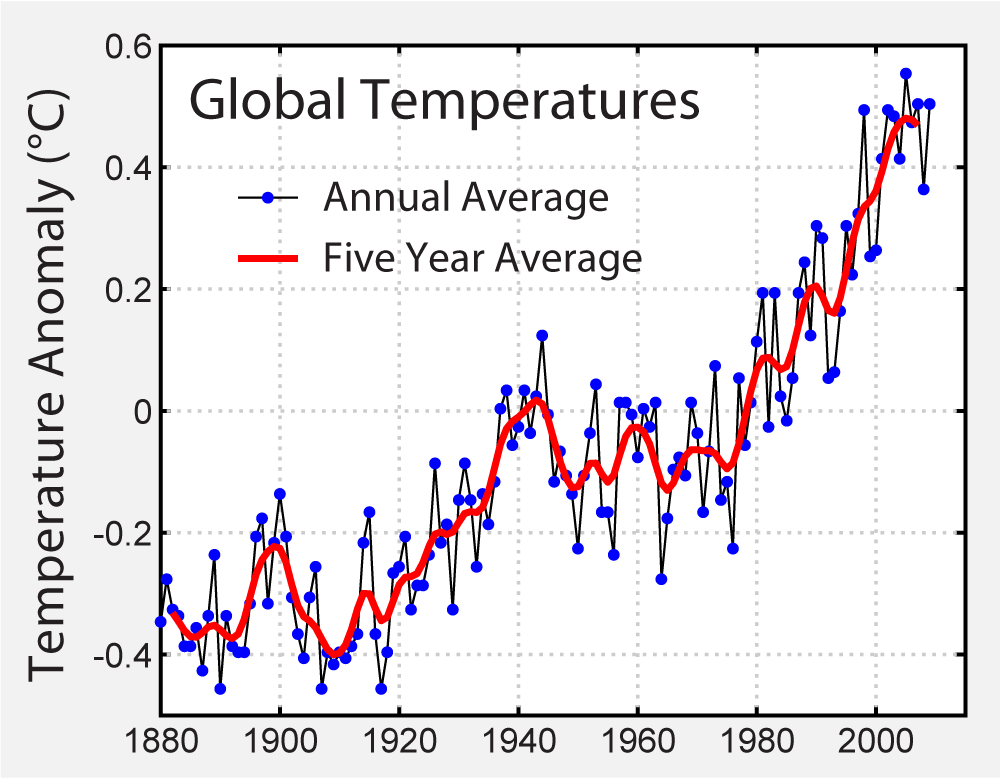 The Maverick Philosopher links to a global warming article by a Harvard Physics professor. The gist of it is that the current “climate crusade” against global warming is a moral epidemic. The notion that increasing atmospheric concentrations of greenhouse gases, notably carbon dioxide, will have disastrous consequences for mankind and for the planet, is based on contested science and dubious claims, he says.
This is a blog which is concerned with ‘sceptical’ issues, so it ought to be concerned with global warming scepticism. But that means scepticism in the strict and proper sense: not holding any positive opinions about p (or not-p), but rather holding that the evidence for p (or not-p) is not sufficient, or reasonable, or conclusive. Humanity is divided into fundamentally two types: those who sit at the front of the class and listen with rapt attention to everything Teacher said (as well as sucking up and toadying to Teacher and all other forms of authority with unquestioning acceptance); and those who sit and the back and talk and throw objects at those in the front, and generally disrepect all forms of authority. True believers at the front, sceptics and disbelievers and mockers and scorners, at the back. The world would be a disastrous place if either type predominated. A world of believers would be dreary and authoritarian if their beliefs were consistent. If not consistent, in would be full of more bloodshed and warfare. In a world of mockers and sneerers, nothing would ever get done, and it would also be boring with no true believers and boy scouts to sneer at and mock.
I am a global warming sceptic in the sense that I remain unconvinced that it exists. Equally I remain unconvinced that it doesn’t exist - being a cautious fellow and mindful of the possibility that it does, I very rarely use a car (the one I bought three years ago has done little more than 5,000 miles), and my heating bills are lower than anyone I know. I am both a global-warming and and anti-global warming sceptic.
Why am I sceptical that it exists? I see a scientific model, and empirical evidence adduced in support of the model. Taking the empirical evidence first, it is primarily statistical, given that the actual temperature data is noisy and subject to error. All kinds of extrapolation and curve-fitting is required to produce the neat ‘hockey stick’ graph that appears to show a constant temperature from the year 1000 until about 1850, when the temperature began to rise like the blade of a hockey stick. Since I don’t accept probabilities between 0 and 1, I don’t accept statistics. The temptation to select data to fit the theory is simply too strong. On the side of the model, there is a robust physical model which predicts rises in temperature for increasing amounts of greenhouse gases in the atmosphere. The problem is that water vapour is also a powerful greenhouse gas, and the amount of water vapour in the atmosphere is difficult to model. Add to that the fact that the effect of carbon dioxide obeys a logarithmic law – to get the same effect as doubling the amount, you have to double it again, and again) – a fact which I have never seen mentioned in any of the global warming propaganda in schools and the mainstream media. Nor is it mentioned in the truly horrible Wikipedia article on the Global Warming controversy. The article simply repeats over and over that there is a scientific consensus on GW (the word ‘consensus’ is repeated 26 times). It gives no substantial arguments or reasoning or basis facts on either side of the debate.
This will probably provoke all sorts of rude emails, to which I say, don’t be rude, just give me a neat Fermi argument to prove to me beyond reasonable doubt that a serious global warming problem exists. I am not interested in what any scientists conclude. I am interested in the basic evidence they have used, and the reasoning process which leads them to their conclusion. Possibility of another £5 Waitrose voucher for any decent answers (I am the final judge however).
Wednesday, June 29, 2011
Isaac Watts on the size of the universe
I read through chapter X of Isaac Watts’ Philosophical Essays, where he talks about light from stars. My memory was bad: it is nothing to do with Olbers' paradox. The first section discusses whether space can be empty or not, and Watts argues it cannot. For light particles are passing through all parts of space in all directions. He gives a neat Fermi-like example. Imagine an auditorium containing a thousand plates, surrounded by an audience of a thousand people. Each person can see each plate. Thus, we can draw a line from any plate to every person. And similarly from any person to every plate. And (assuming light is particles) there is a constant emission of particles filling the air. The same must be true of space and the light emitted from stars. Thus, space must be full up of light particles. He wonders why the planets are not slowed down by all of this (an interesting question that I will leave to the experts).
The second section is on whether the universe is infininitely large or not. Watts argues not. For although the Earth was created by God 6,000 years ago (remember the time he was writing, in 1742), it is probable that the other solar systems were created long before that. In which case, if the light particles were being constantly emitted from the stars, the universe would be all used up and dark and dead, which it isn’t.
He mentions with apparent approval the opinion that when light particles are emitted from a star, gravity eventually draws them back to their source. Thus the universe will not be depleted by the constant emission of light, and it will have a finite size.
I was surprised to find he knows the speed of light (“one hundred and four score miles per second of the Minute”). I always imagined this was a nineteenth century discovery.
The second section is on whether the universe is infininitely large or not. Watts argues not. For although the Earth was created by God 6,000 years ago (remember the time he was writing, in 1742), it is probable that the other solar systems were created long before that. In which case, if the light particles were being constantly emitted from the stars, the universe would be all used up and dark and dead, which it isn’t.
He mentions with apparent approval the opinion that when light particles are emitted from a star, gravity eventually draws them back to their source. Thus the universe will not be depleted by the constant emission of light, and it will have a finite size.
I was surprised to find he knows the speed of light (“one hundred and four score miles per second of the Minute”). I always imagined this was a nineteenth century discovery.
Monday, June 27, 2011
Olbers' paradox
Hunting through the internet to find something about Hubble's constant I found something on Olbers' paradox. The Wikipedia article is not bad (but I have never disputed Wikipedia's generally good coverage of non-soft subjects). The paradox is that a static, infinitely old universe with an infinite number of stars distributed in an infinitely large space would be bright rather than dark. For if there were an infinite number of stars, evenly dispersed, the then for any angle of vision, the number of stars would be proportional, but the intensity of light inversely proportional to the square of distance. The two effects would cancel out thus, with an infinite number of stars, the sky would be uniformly bright, which it isn't.
The article says that Olbers was not the first to describe the paradox, without mentioning any earlier description. I remember reading a similar paradox by the English logician (and hymn writer) Isaac Watts (1674–1748), I shall look for his book tonight, and report back.
Meanwhile - and this is really a philosophical question - why is Hubble's constant a constant?
The article says that Olbers was not the first to describe the paradox, without mentioning any earlier description. I remember reading a similar paradox by the English logician (and hymn writer) Isaac Watts (1674–1748), I shall look for his book tonight, and report back.
Meanwhile - and this is really a philosophical question - why is Hubble's constant a constant?
Thursday, June 23, 2011
Ad tertium
I reply to the third of the four arguments for direct reference. The argument was that definition proceeds by genus and specific difference. Therefore a proper name cannot be defined, for they name individuals, and individuals are not species. They have no specific difference, and can only be distinguished by the proper name itself.
I reply by conceding that a proper name cannot be defined, and that a proper name does not signify a species or kind of thing. But I deny that "an individual can only be distinguished by the name itself". As I have argued, signification is not a relation between a name and a thing, and so a proper name does not distinguish an individual in any strict and proper sense (although I concede that in an improper sense it is true that the name 'Frodo' distinguishes a certain fictional hobbit, as I argued here and in other places). We do not learn the meaning of a proper name by definition or by acquaintance with an individual, but rather by acquaintance with the name itself. When we first encounter the name, as Bosanquet says, it has a purely general sense: someone so-called. When we next encounter it, it means the same thing as whatever it meant before. "Aeneas fled his home ... Aeneas was shipwrecked" means simply that someone fled their home and that the same person was shipwrecked. We don't know who Aeneas was in any stronger sense than this.
I reply by conceding that a proper name cannot be defined, and that a proper name does not signify a species or kind of thing. But I deny that "an individual can only be distinguished by the name itself". As I have argued, signification is not a relation between a name and a thing, and so a proper name does not distinguish an individual in any strict and proper sense (although I concede that in an improper sense it is true that the name 'Frodo' distinguishes a certain fictional hobbit, as I argued here and in other places). We do not learn the meaning of a proper name by definition or by acquaintance with an individual, but rather by acquaintance with the name itself. When we first encounter the name, as Bosanquet says, it has a purely general sense: someone so-called. When we next encounter it, it means the same thing as whatever it meant before. "Aeneas fled his home ... Aeneas was shipwrecked" means simply that someone fled their home and that the same person was shipwrecked. We don't know who Aeneas was in any stronger sense than this.
Wednesday, June 22, 2011
On human happiness
To be stupid, and selfish, and to have good health are the three requirements for happiness; though if stupidity is lacking, the others are useless. (Flaubert)
Monday, June 20, 2011
offline
I've been quiet for a few days, but with good reason: my phone line has gone down. British Telecom have a helpful booklet including a number to ring if your phone is out of order, but of course that was no good. Similarly they provide a link to their website, but with the actual line down, the broadband goes too.
Hopefully I will be back this week.
Hopefully I will be back this week.
Thursday, June 16, 2011
A Fermi Challenge
Here’s an example I love, and which illustrates my problem with sceptics who are too keen on ‘argument from authority’. There's more about it here. The great physicist Enrico Fermi was fond of setting problems that seem difficult to solve, but which can be approached by a mixture of logic and common sense (and particularly without any appeal to ‘scientific’ knowledge or complex mathematics). One such problem was that of estimating the number of piano tuners in Chicago given only the population of the city. This seemed impossible to his students, but is fairly straightforward to resolve as follows.
As an exercise, what is the simplest argument against the Young Earth Creationism - the theory that God created the world about 5,700 years ago? Most people now accept that God created the world (together with time and space, and the number system) more than 14 billion years ago. But why do they accept that? What is the simplest argument for the generally accepted age of the universe that you could write down on a credit card, and which you could explain to a 9 year old? You will find that this article, which is completely incomprehensible, is absolutely no use. I offer a prize of a £5 Waitrose voucher to the first decent reply to my challenge.
- From the almanac (the only authority required), Chicago has a population of about 3 million people.
- Assume that an average family contains four members (Fermi was teaching in the 1930s when families were that large).
- Therefore the number of families in Chicago is about 750,000.
- If one in five families owns a piano, there will be 150,000 pianos in Chicago.
- If the average piano tuner serviced four pianos every day of the week for five days rested on weekends, and had a two week holiday during the summer, then in one year (52 weeks) he would service 1,000 pianos. 150,000/(4 x 5 x 50) = 150, so that there must be about 150 piano tuners in Chicago.
As an exercise, what is the simplest argument against the Young Earth Creationism - the theory that God created the world about 5,700 years ago? Most people now accept that God created the world (together with time and space, and the number system) more than 14 billion years ago. But why do they accept that? What is the simplest argument for the generally accepted age of the universe that you could write down on a credit card, and which you could explain to a 9 year old? You will find that this article, which is completely incomprehensible, is absolutely no use. I offer a prize of a £5 Waitrose voucher to the first decent reply to my challenge.
Wednesday, June 15, 2011
Phantom Time continued
I continue to be perplexed by the strange hypothesis of Dr. Hans-Ulrich Niemitz which I discussed yesterday. Namely that the early middle ages never existed. This morning I checked in Bede (b. 673, some way into the non-existent period), and English monk who wrote a well known and extensive history of his country, to see if the period really was missing. All the evidence from his book suggests that it really was there. For example, he writes
Bede gives us plenty of both types of dating. In nearly all of the chapters he gives the Christian chronology (‘in the year of our lord’), and in the early ones he connects this with the Roman chronology (“Britain remained unknown and unvisited by the Romans until the time of Gaius Julius Caesar, who became consul with Lucius Bibulus 693 years after the founding of Rome, and sixty years before the birth of our Lord”). For the period from the 620s until his birth (in about 673) he simply gives relative dating (‘the glorious reign of Edwin over English and Britons alike lasted seventeen years’).
There is also another piece of evidence locked up in that passage, namely that the date (12 April 627) is recorded so precisely. There are many such examples in his work, and it is evidence of a precise recording system. If such a system existed, the probability of 300 years going ‘missing’ is improbable in the extreme.
Now it could be argued that Bede’s history was a Christian forgery, as Niemitz suggests happened in the case of Charlemagne. But then we have a number of different series of reigns, produced by almost completely independent sources. For example, French kings, English kings, Castilian monarchs, German emperors and other varieties of monarch, and many others. Could the apparently independent sources for these series have been a forgery? Who coordinated it, and why?
There is a discussion of Niemitz here, but it is a sceptic website, and the big problem I have with sceptic websites is that they love to poke fun at silly theories, without adequately explaining what is silly about them. Should we even bother? Yes, because silly people (a group which includes many intelligent and apparently well-educated people) often believe such silly theories, in many cases precisely because of the way that they are dismissed out of hand by 'scientists'. Here we come to another gripe I have against Wikipedia, but that must wait until tomorrow. For a foretaste, have a look at this.
*We can now date terrestrial events relative to the creation of the universe. But this is still a relative date. Assuming that time did not exist before the universe began, does it make sense to say that God could have created the universe a few days earlier? This raises the question of what God was doing before he created the universe, but that is too difficult and extensive a question to discuss here.
King Edwin, with all the nobility of his kingdom and a large number of humbler folk, accepted the faith and were washed in the cleansing water of baptism in the eleventh year of his reign, which ws the year of our Lord 627, and about one hundred and eighty years after the first arrival of the English in Britain. The king’s baptism took place at York on Easter Day, the 12th of April, in the church of St Peter the Apostle.This neatly shows the two different ways in which we can use historical documents to reconstruct the past. Namely, relative dating (‘the eleventh year of his reign’, ‘one hundred and eighty years after the first arrival of the English in Britain’) and absolute dating (‘12th of April 627’). Absolute dates are absolute, of course. And relative dating can be used to reconstruct absolute dates. If you can tie relative dates together, which is easy to do in the case of reigns, which are contiguous (i.e. one when reign stops, the next one begins) then you can construct an ‘absolute’ series of dates, anchored on today’s date. Note that ‘absolute’ dates, of course, are merely relative dates anchored in a single date*.
Bede gives us plenty of both types of dating. In nearly all of the chapters he gives the Christian chronology (‘in the year of our lord’), and in the early ones he connects this with the Roman chronology (“Britain remained unknown and unvisited by the Romans until the time of Gaius Julius Caesar, who became consul with Lucius Bibulus 693 years after the founding of Rome, and sixty years before the birth of our Lord”). For the period from the 620s until his birth (in about 673) he simply gives relative dating (‘the glorious reign of Edwin over English and Britons alike lasted seventeen years’).
There is also another piece of evidence locked up in that passage, namely that the date (12 April 627) is recorded so precisely. There are many such examples in his work, and it is evidence of a precise recording system. If such a system existed, the probability of 300 years going ‘missing’ is improbable in the extreme.
Now it could be argued that Bede’s history was a Christian forgery, as Niemitz suggests happened in the case of Charlemagne. But then we have a number of different series of reigns, produced by almost completely independent sources. For example, French kings, English kings, Castilian monarchs, German emperors and other varieties of monarch, and many others. Could the apparently independent sources for these series have been a forgery? Who coordinated it, and why?
There is a discussion of Niemitz here, but it is a sceptic website, and the big problem I have with sceptic websites is that they love to poke fun at silly theories, without adequately explaining what is silly about them. Should we even bother? Yes, because silly people (a group which includes many intelligent and apparently well-educated people) often believe such silly theories, in many cases precisely because of the way that they are dismissed out of hand by 'scientists'. Here we come to another gripe I have against Wikipedia, but that must wait until tomorrow. For a foretaste, have a look at this.
*We can now date terrestrial events relative to the creation of the universe. But this is still a relative date. Assuming that time did not exist before the universe began, does it make sense to say that God could have created the universe a few days earlier? This raises the question of what God was doing before he created the universe, but that is too difficult and extensive a question to discuss here.
Tuesday, June 14, 2011
Phantom Time Hypothesis
I nearly bought a Fortean Times today (surprisingly our newsagent keeps a number of copies in his shelf) but resisted the temptation. What caught my eye was the surprising assertion that the early Middle Ages did not exist. There is a paper about it online here, but the essence of it is this. The theory begins with Heribert Illig (b. 1947), who was puzzled about why the correction between the Gregorian calendar and the old Julian calendar of Julius Caesar was as much as 10 days.
That's a very interesting theory for us medieval philosophers, who focus almost exclusively in the post Carolingian period, by reason of the paucity of literature in the intervening period. If that period simply did not exist, then the lack of literature can easily be explained, because no one existed to write it. If the dark ages did not exist, then Boethius, writing in about 520 (or 820 on the PTH theory) was nearly contemporary with John Scotus Eruigena (c. 815 – c. 877). There would be no 'gaps' to explain.
Other things are less conveniently explained (such as the venerable Bede, who appeared to have been writing bang in the middle of the phantom period). Presumably people counted the years as they went by. Assuming there were no written records whatsoever, and no archeology to speak of, and assuming that different people counted the years as they went by, with only the record of the current year. What is the probability of miscomputing the year? Indeed, what is the probability of different groups consistently miscomputing the date, so that they all all arrived at the same, but consistently wrong answer? How could they consistently lose more than 300 years?
Now please calculate: how many Julian years does it take to produce an error of 10 days? The answer is 1257 years. The question – at which date was the Julian calendar correct – can be calculated with the following amazing result (Illig 1991): 1582 – 1257 = 325Thus there are about 300 'phantom years' that history says exist, but didn't. Thus the whole period 600-900 A.D. never existed.
That's a very interesting theory for us medieval philosophers, who focus almost exclusively in the post Carolingian period, by reason of the paucity of literature in the intervening period. If that period simply did not exist, then the lack of literature can easily be explained, because no one existed to write it. If the dark ages did not exist, then Boethius, writing in about 520 (or 820 on the PTH theory) was nearly contemporary with John Scotus Eruigena (c. 815 – c. 877). There would be no 'gaps' to explain.
Other things are less conveniently explained (such as the venerable Bede, who appeared to have been writing bang in the middle of the phantom period). Presumably people counted the years as they went by. Assuming there were no written records whatsoever, and no archeology to speak of, and assuming that different people counted the years as they went by, with only the record of the current year. What is the probability of miscomputing the year? Indeed, what is the probability of different groups consistently miscomputing the date, so that they all all arrived at the same, but consistently wrong answer? How could they consistently lose more than 300 years?
Friday, June 10, 2011
On miracles, the supernatural and the burden of proof
Vallicella of Phoenix has an interesting and worthwhile series of posts on the burden of proof, of which the latest is here. In that, he writes
Second, I don’t believe there is any such kind of thing as a miracle (or supernatural event). But there are kinds of accounts, which fall into several easily identifiable patterns. For example, if we define ‘miracle’ as the purported referent of an account which is inherently implausible and unsupported by any strong evidence (and usually and in addition there exists evidence that the claim is being made for reasons unrelated to scientific objectivity) of course the default position is to reject miracles, and the burden of proof is to supply the evidence that is conspicuously lacking.
It is not that scientists hold a strong presumption in favour of the nonexistence of a certain type of event (‘the nonnatural’), as Vallicella appears to suggest. Rather, that there is a strong presumption by scientists in favour of rejecting the existence of anything referred to by a certain type of account. The ‘burden of proof’ is merely the requirement to supply a certain kind of account.
For one who plays the scientific 'game' and abides by its rules, there is no question but that the burden of proof lies on the one who asserts that there are miracles. No scientist worth his salt could hold that there is a presumption in favor of the existence of miracles. It is the other way around: there is an exceedingly strong, if not quite indefeasible, presumption in favor of their nonexistence, and indeed of the nonexistence of anything nonnatural. But this onus-assignment is relative to the scientific 'game' and partially constitutive of it.Two points. First, I don’t believe there is any scientific ‘game’. The burden of proof is simply to show that any event, or kind of event exists. The default position is to reject all existence claims – not just miracles.
Second, I don’t believe there is any such kind of thing as a miracle (or supernatural event). But there are kinds of accounts, which fall into several easily identifiable patterns. For example, if we define ‘miracle’ as the purported referent of an account which is inherently implausible and unsupported by any strong evidence (and usually and in addition there exists evidence that the claim is being made for reasons unrelated to scientific objectivity) of course the default position is to reject miracles, and the burden of proof is to supply the evidence that is conspicuously lacking.
It is not that scientists hold a strong presumption in favour of the nonexistence of a certain type of event (‘the nonnatural’), as Vallicella appears to suggest. Rather, that there is a strong presumption by scientists in favour of rejecting the existence of anything referred to by a certain type of account. The ‘burden of proof’ is merely the requirement to supply a certain kind of account.
Thursday, June 09, 2011
Ad secundum
I reply to the second argument of the four arguments for direct reference. The argument was that a name cannot be significant or intelligible to another unless the idea of what the name applies to is in the other person’s mind. Thus the meaning of most proper names is unknown to nearly all people in the world; they have no corresponding words in other languages. We can only have the idea of a particular thing by being acquainted with that thing, which is only possible if that thing actually exists. It follows that the meaning of a proper name involves direct acquaintance with the individual for which it is a name.
There a number of things to criticise in the argument. For example, the assumption that we use language as it were to evoke the ‘same idea’ in someone else’s mind. This goes back at least to Aristotle – “Just as all men have not the same writing, so all men have not the same speech sounds, but the mental experiences, which these directly symbolize, are the same for all, as also are those things of which our experiences are the images” (On Interpretation, ch. 1). This is questionable – as Frege argued, the distinction between things, meanings and ideas is analogous to that between the moon, which is publicly observable, the image of the moon in a camera or telescope, which is publicly observable, and the retinal image, which is not.
On the fact that the meaning of most proper names is unknown to most people in the world, this is no more significant than the fact (assuming it is a fact) that eskimos have many different words for types of snow. And proper names are a part of a language if they are a significant part of the literature of that language. My Latin dictionary contains the Latinised form of all the main characters in Latin literature. Many of these are fictional, of course. All reference, I claim, is story relative reference.
There a number of things to criticise in the argument. For example, the assumption that we use language as it were to evoke the ‘same idea’ in someone else’s mind. This goes back at least to Aristotle – “Just as all men have not the same writing, so all men have not the same speech sounds, but the mental experiences, which these directly symbolize, are the same for all, as also are those things of which our experiences are the images” (On Interpretation, ch. 1). This is questionable – as Frege argued, the distinction between things, meanings and ideas is analogous to that between the moon, which is publicly observable, the image of the moon in a camera or telescope, which is publicly observable, and the retinal image, which is not.
The reference of a proper name is the object itself which we designate by its means; the idea, which we have in that case, is wholly subjective; in between lies the sense, which is indeed no longer subjective like the idea, but is yet not the object itself. The following analogy will perhaps clarify these relationships. Somebody observes the Moon through a telescope. I compare the Moon itself to the reference; it is the object of the observation, mediated by the real image projected by the object glass in the interior of the telescope, and by the retinal image of the observer. The former I compare to the sense, the latter is like the idea or experience. The optical image in the telescope is indeed one-sided and dependent upon the standpoint of observation; but it is still objective, inasmuch as it can be used by several observers. At any rate it could be arranged for several to use it simultaneously. But each one would have his own retinal image [On Sense and Reference].But that would take us too far afield. The objection errs in assuming that the meaning of a proper name cannot be communicated to another person, other than by direct acquaintance with the object that it names. But of course it can. As I commented here, the first time we encounter a proper name in a particular context, it signifies (for us) no more than a general idea - “Some Trojan warrior called ‘Aeneas’” perhaps. But every subsequent time we encounter the name, it has a definite and singular sense: the very same person as that Trojan warrior. It signifies merely that every sentence containing it is true – if true at all – of a single person. It signifies no more than that. And we easily learn this signification without being ‘acquainted’ – whatever that means – with the person who is named. That is how we learned the signification of the name ‘Jesus’, as I argued here and elsewhere.
On the fact that the meaning of most proper names is unknown to most people in the world, this is no more significant than the fact (assuming it is a fact) that eskimos have many different words for types of snow. And proper names are a part of a language if they are a significant part of the literature of that language. My Latin dictionary contains the Latinised form of all the main characters in Latin literature. Many of these are fictional, of course. All reference, I claim, is story relative reference.
Tuesday, June 07, 2011
Charley’s (single) ant
 And here is another interesting paper by Greg Frost-Arnold, “Too much reference”. He considers the case in some way opposite to empty singular terms: where a singular term ‘refers to’ more than thing.
 He writes:
Suppose a person purchases an ant colony. There are many small ants in the colony, and two big ants, Ant A and Ant B. However, the owner of the ant colony does not realize that there are actually two big ants, because he only sees one big ant at a time. (We assume the ants’ behavior is coordinated to satisfy this condition.) The owner believes that there is one big ant in the colony, and the owner decides to name this ant ‘Charley.’ The philosophical issue such a story raises is this: what is the semantic status of sentences that include the term ‘Charley’?This is a case I discussed, with reference to a Bunuel film, here and here. There are actually two people (Carole Bouquet and Angela Molina) playing the same character (Conchita). Does the name ‘Conchita’ refer to two people – for once you have realised the trick, it is obvious that there are really two characters – or one? Or (pace Greg) to none at all?
If the theory of reference (the ‘Frodo’-Frodo theory) I have argued for is correct, this sort of multiple reference is impossible. The meaning of a name is exhausted by its function of purporting to signify the same thing. To understand the sentences ‘Fa’ and ‘Ga’ is to understand that if they are both true, then “some F is G” is also true. And, because they do not imply that some Fs are G, they they can only imply that one F is G. To say that there are two F’s is to say that there is an F, and there is another F. The word ‘another’ is the complement of a singular term. It always means a different thing, and for there to be one different thing means there being at least two different things.
What about the ants? Can’t it plausibly said that the proper name ‘Charley’ refers both to Ant 1 and to Ant 2? No, because, as I have argued, reference is not a semantic relation between language and reality. As I have argued, we can regard the two ant images as visual proper names. I see ant 1 walking out of the colony, and entertain the visual proposition ‘Here is an ant’. Ant 1 goes back, and ant 2 now comes out. I entertain the visual proposition ‘Here is the same ant’. Since I cannot understand this visual singular as applying to more than one singular, i.e. because I understand it always as meaning ‘the same …’, I cannot understand it as multiple reference. Thus it cannot be multiple reference. Singular terms always refer to singular things.
Monday, June 06, 2011
Is Atlantis West of London?
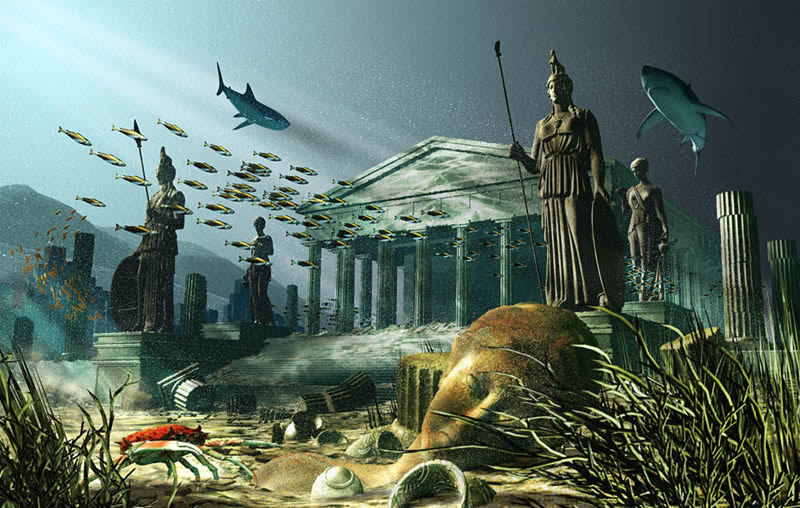 I just spotted this excellent post from May 2008, by philosopher Greg Frost-Arnold. He says that, in negative free logic (a variety of which I have argued for here, across too many posts to mention), all atomic sentences containing non-denoting names are false. But this leads to the following problem, he says. Assume, as seems probable, that 'Atlantis' is a non-denoting name. Then in negative free logic, all three of the following sentences must be false.
(1) Atlantis is West of London.
(2) Atlantis is East of London.
(3) Atlantis and London have the same longitude.
But 'x is west of y' means the same as 'x is not east of y, and x does not have the same longitude as y', and now we have a problem.
If 'Atlantis is west of London' is false (as the free logician says), then at least one of 'Atlantis is east of London' or 'Atlantis and London the same longitude' has to be true -- but that contradicts the earlier assumption (of the negative free logician) that all of (1)-(3) are false.He asks "Does anyone see a good response to this objection on behalf of the proponent of negative free logic?" I answer: the objection relies, first, on the perfectly valid assumption that if p is equivalent to "~q and ~r", then ~p is equivalent to "q or r". Second, it relies on the invalid assumption that "Atlantis is West of London" is equivalent to a conjunction of two negatives. On the contrary, it is equivalent to the conjunction of two affirmatives. It is equivalent (according to our variety of NFL) to "something which is identical with Atlantis is West of London". This in turn is equivalent to "something which is identical with Atlantis is neither East of London nor has the same longitude as London". And the negation of that is
(4) It is not the case that something identical with Atlantis is not East of London, or it is not the case that something identical with Atlantis does not have the same longitude as London.
Now if (1) is false then (4) is true, and if Atlantis exists, it follows that Atlantis is East of London, or that Atlantis and London have the same longitude (I will omit the proof, which is elementary). But if Atlantis does not exist, both (2) - which is equivalent to "something which is identical with Atlantis is East of London" - and (3) - which is equivalent to "something which is identical with Atlantis has the same longtitude as London" - are false. For the presumption is that nothing is identical with Atlantis.
This requires the negative free logician to bite a bullet, but it is not the unpalatable one that Frost-Arnold suggests. We have to concede that sentences like "Atlantis is large" and "Atlantis is not large" are not true contradictories, but contraries. The second is not the negation of the first. The true negation of the first is "notthing is Atlantis or Atlantis is not large". But there cannot be simple solutions in philosophy. When we have exhausted everything that is wrong, what remains must be right.
Saturday, June 04, 2011
Direct Reference - ad primum
I reply to the first argument of the four arguments for direct reference. The argument was that a proper name does not signify something that is repeatable, therefore does not signify a property. Therefore it signifies an object.
I reply: the argument relies on the assumption that a a term signifies either a property (which is repeatable) or an object (which is not). This is false. As I have argued before, the entire significance of a proper name is to signify that (if we are talking about anything at all) we are talking about a single thing. In other words, Fa and Ga imply that some F is G, if 'a' is functioning as a proper name. Thus it cannot signify anything repeatable like a property, by reason of its peculiar semantic function. 'Fa' and 'Ga' always imply that 'F' and 'G' apply to a single thing. Thus it makes no sense to say that this individual is Socrates on Tuesday, but that someone else is Socrates on Wednesday. Or that this individual is Socrates today, but might not have been Socrates.
Nor does a proper name signify an object. Sentences containing the same proper name, accepted in the same sense, are true of the same thing, if they are true at all. But they do not have to be true of anything at all, in order for us to understand this.
I reply: the argument relies on the assumption that a a term signifies either a property (which is repeatable) or an object (which is not). This is false. As I have argued before, the entire significance of a proper name is to signify that (if we are talking about anything at all) we are talking about a single thing. In other words, Fa and Ga imply that some F is G, if 'a' is functioning as a proper name. Thus it cannot signify anything repeatable like a property, by reason of its peculiar semantic function. 'Fa' and 'Ga' always imply that 'F' and 'G' apply to a single thing. Thus it makes no sense to say that this individual is Socrates on Tuesday, but that someone else is Socrates on Wednesday. Or that this individual is Socrates today, but might not have been Socrates.
Nor does a proper name signify an object. Sentences containing the same proper name, accepted in the same sense, are true of the same thing, if they are true at all. But they do not have to be true of anything at all, in order for us to understand this.
Friday, June 03, 2011
The arguments for direct reference (review)
I've been away for a week. Now I am back, and it is time to review the arguments for direct reference that we considered earlier, and to prepare for a reply.
Argument 1 was that a proper name does not signify something that is repeatable, therefore does not signify a property. Therefore it signifies an object.
Argument 2 was that a name cannot be significant or intelligible to another unless the idea of what the name applies to is in the other person’s mind. But we can only have the idea of a particular thing by being acquainted with that thing, which is only possible if that thing actually exists.
Argument 3 was that definition proceeds by genus and specific difference. Therefore a proper name cannot be defined, for they name individuals, and individuals are not species. They have no specific difference, and can only be distinguished by the proper name itself.
Argument 4 was that truth-conditional semantics rests on the assumption that the conditions for the truth of a sentence give the sentence’s meaning or significance. But there is no truth evaluable content when reference failure occurs. If there are no truth conditions, then there is no meaning or significance.
More later. Have a good weekend, readers.
Argument 1 was that a proper name does not signify something that is repeatable, therefore does not signify a property. Therefore it signifies an object.
Argument 2 was that a name cannot be significant or intelligible to another unless the idea of what the name applies to is in the other person’s mind. But we can only have the idea of a particular thing by being acquainted with that thing, which is only possible if that thing actually exists.
Argument 3 was that definition proceeds by genus and specific difference. Therefore a proper name cannot be defined, for they name individuals, and individuals are not species. They have no specific difference, and can only be distinguished by the proper name itself.
Argument 4 was that truth-conditional semantics rests on the assumption that the conditions for the truth of a sentence give the sentence’s meaning or significance. But there is no truth evaluable content when reference failure occurs. If there are no truth conditions, then there is no meaning or significance.
More later. Have a good weekend, readers.
Saturday, May 28, 2011
Wittgenstein on identity
 Tractatus 5.5303 - "Roughly speaking, to say of two things that they are identical is nonsense, and to say of one thing that it is identical with itself is to say nothing at all.
Friday, May 27, 2011
Can crowdsourcing make all articles excellent?
Ex-climate scientist William Connolley questions the logic of an earlier post, saying that
On the other possible claims that William mentions, I disagree that "crowdsourcing makes all wikipedia articles excellent" is trivially false. Since we agree it is false, it follows that crowdsourcing fails to make certain articles excellent, and it is an interesting, and therefore non-trivial, question whether there are certain types of article, or certain types of information that crowdsourcing fails to make excellent, and if so why.
I don't propose to answer these non-trivial questions here - I merely point out that they are obviously non-trivial. I have made suggestions in the past. I suggested that "crowdsourcers are typically shy of deleting material, so articles tend to grow to the point of being unreadable. Second, they have no sense of where material ought to go. So the article tends to lose any basic thread it once had. Third, they have no sense of which facts to include, and which to leave out. What facts about Aristotle would you include in a three page article?". I have also observed that, as a general rules, Wikipedia's coverage of subjects like Boron and set theory is pretty good. On the arts and humanities it is a complete disaster. As Vaknin says, "they are replete with nonsense, plagiarism, falsities, and propaganda".
So it's an interesting question as to whether the poor quality of arts subjects is simply a matter of accident, and could have been the other way round. Another interesting (and therefore non-trivial) question is whether crowdsourcing is better at 'low culture' than 'high culture'. My view is that it is pretty good at articles like this, but really dreadful at articles like this. More later.
I'm not really sure exactly what claim about crowdsourcing you are calling false. If the claim is, crowdsourcing makes all wikipedia articles excellent, then it is trivially false. If the claim is, crowdsourcing is capable of creating excellent articles, then it is trivially true. Probably you mean something else, but what?Well, as to exactly what claim of crowdsourcing I was originally calling false, in this post I cited the articles on Durandus and Roscellinus as evidence against the claim that crowdsourcing makes Wikipedia "instantly responsive to new developments". The fact that these articles are entirely plagiarised or 'copied' from the 1913 Catholic Enyclopedia and Britannica 1911 suggests that Wikipedia is somewhat sluggish on the 'new development' front.
On the other possible claims that William mentions, I disagree that "crowdsourcing makes all wikipedia articles excellent" is trivially false. Since we agree it is false, it follows that crowdsourcing fails to make certain articles excellent, and it is an interesting, and therefore non-trivial, question whether there are certain types of article, or certain types of information that crowdsourcing fails to make excellent, and if so why.
I don't propose to answer these non-trivial questions here - I merely point out that they are obviously non-trivial. I have made suggestions in the past. I suggested that "crowdsourcers are typically shy of deleting material, so articles tend to grow to the point of being unreadable. Second, they have no sense of where material ought to go. So the article tends to lose any basic thread it once had. Third, they have no sense of which facts to include, and which to leave out. What facts about Aristotle would you include in a three page article?". I have also observed that, as a general rules, Wikipedia's coverage of subjects like Boron and set theory is pretty good. On the arts and humanities it is a complete disaster. As Vaknin says, "they are replete with nonsense, plagiarism, falsities, and propaganda".
So it's an interesting question as to whether the poor quality of arts subjects is simply a matter of accident, and could have been the other way round. Another interesting (and therefore non-trivial) question is whether crowdsourcing is better at 'low culture' than 'high culture'. My view is that it is pretty good at articles like this, but really dreadful at articles like this. More later.
Thursday, May 26, 2011
The Logic Museum is excommunicated
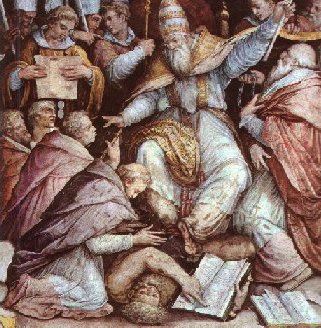 Today is May 26, the anniversary of my namesake William of Ockham's flight from Avignon after a dispute with the Pope about Franciscan poverty. That strangely coincides with two other related things.
 First, the excommunication of my website The Logic Museum from Wikipedia. This means that any mention of the Museum, or any outbound link to it from Wikipedia, is now prohibited. As my readers will know, the Museum is primarily a repository of primary sources on logic, mainly medieval texts, that are difficult to locate even in a good university library (some of the texts I plan on publishing are unavailable even in London). What did the poor creature do to deserve this? (I am told it is because of my criticism of Wikipedia here, and because of other criticism by the owner of the hosting site, Greg Kohs).
Second, Ockham's flight is mentioned on the main page of Wikipedia - see the in the 'on this day' column. "On this day ... 1328 – William of Ockham, originator of the methodological principle Occam's razor, secretly left Avignon under threat from Pope John XXII". This is ironic. As every medieval scholar knows, Ockham was not the originator of this principle at all (although he often used it, and it bears his name). If they had been allowed to link to the Logic Museum, Wikipedians would have learned this. They could have looked at this essay by Thorburn, who first debunked the claim nearly 100 years ago. Or they could look in the article on Ockham in the Logic Museum. But they can't.
And as I commented last year, there are many mistakes in the article itself. Some were cleaned up (by someone I notified by email). But, as of this morning, many errors or significant omissions remain.
- The most significant error in the article still remained until this morning (when someone spotted a draft of this post and changed it. It said that Ockham does accept the Principle of Sufficient Reason, when of course he clearly doesn't. Until this morning, that mistake was there for five years. And there is still a problem, because the claim is spliced with an unrelated one sourced from the Catholic Encyclopedia, about Ockham's view on the distinction between essence and existence, between the active and passive intellect.
- It stills contains the odd claim that Ockham has been called a "terminist", to distinguish him from a nominalist or a conceptualist, is from the Catholic Encyclopedia. Thus the article combines what is probably wrong ('terminism' can be consistent with nominalism**) with the section from the SEP which is intended for an academic audience, and is impenetrable out of context.
- As I commented just this week, the article on Durandus does not mention that Durandus was one of those assigned by John XXII to investigate Ockham’s nominalism. That is because the whole article was plagiarised from the Catholic Encyclopedia, written 100 years ago. Nor does the article on Ockham.
If you feel strongly about this, and I think you should, you can comment on Jimmy Wales page here.
** Particularly in the case of Ockham's nominalism, defined as the view that we should not multiply entities according to the multiplicity of names.
Wednesday, May 25, 2011
Plagiarism from old sources
I had a mild disagreement with climate scientist William Connolley here on my use of the term 'plagiarism'. He objected that the articles in question did mention that they 'incorporate' material from the Catholic Enyclopedia. This is a matter of semantics. To my mind the word 'incorporates' suggests 'proper subset of' rather then 'equals', but let's pass over that. It matters in a very real way that the magic of crowdsourcing is little more than indiscriminate copying of the scholarship of a century ago.
The article Durandus misses all the medieval scholarship that happened from around 1913 until now. In the case of medieval studies, that is quite a lot. The discipline did not really get started until the nineteenth century, and much of the primary source material - the works themselves - did not become available until well into the twentieth century. (Indeed, the work that Jack and I are currently translating did not become available in a critical edition until a few years ago, and has never been published in English).
Thus the Wikipedia article necessarily misses some important facts. For example, that Durandus was one of those assigned by John XXII to investigate Ockham’s nominalism. Or the centrality of his work on the category of relation – first highlighted by Koch in 1927. The article does not even mention the dates of Durandus’ work (the first Sentences commentary between 1303-8, the second between 1310-12) and omits to mention a number of his other works. As any scholar knows, assigning a date to a source is of crucial importance, and is a painful business. Wikipedia, which is good at basic facts, and lists of things, would be an ideal source of such information. But it isn't.
You will say I am knocking Wikipedia again. But the point underlying this is not to knock Wikipedia, but rather a false claim about 'crowdsourcing'. We should be thanking the scholars of 100 years ago for Wikipedia, not the crowd (or Jimmy Wales, who is supposed to have invented the whole thing).
The article Durandus misses all the medieval scholarship that happened from around 1913 until now. In the case of medieval studies, that is quite a lot. The discipline did not really get started until the nineteenth century, and much of the primary source material - the works themselves - did not become available until well into the twentieth century. (Indeed, the work that Jack and I are currently translating did not become available in a critical edition until a few years ago, and has never been published in English).
Thus the Wikipedia article necessarily misses some important facts. For example, that Durandus was one of those assigned by John XXII to investigate Ockham’s nominalism. Or the centrality of his work on the category of relation – first highlighted by Koch in 1927. The article does not even mention the dates of Durandus’ work (the first Sentences commentary between 1303-8, the second between 1310-12) and omits to mention a number of his other works. As any scholar knows, assigning a date to a source is of crucial importance, and is a painful business. Wikipedia, which is good at basic facts, and lists of things, would be an ideal source of such information. But it isn't.
You will say I am knocking Wikipedia again. But the point underlying this is not to knock Wikipedia, but rather a false claim about 'crowdsourcing'. We should be thanking the scholars of 100 years ago for Wikipedia, not the crowd (or Jimmy Wales, who is supposed to have invented the whole thing).
Tuesday, May 24, 2011
Ontological argument on Youtube
Yes really. You can tell it's the internet because someone has commented "that's an awesome argument" and puts a smiley face at the end :(
With Zimmerman and Plantinga - it does at least include what Anselm actually says.
With Zimmerman and Plantinga - it does at least include what Anselm actually says.
Reference and intention
In my last post I asked which towers Tolkien was referring to in his title 'The Two Towers'. I should have said intending to refer to. For (as I am using the term), we cannot fail to refer. I argued this here, but there is more to say. Consider:
The possibility of there being separate 'referential chains' within a narrative which are identified as co-referring at some later point provides a device that writers have used for dramatic purposes. In Dumas' The Vicomte de Bragellone, we are introduced to a traveller at a hostelry in Blois, 'a man of scarcely 30 years, handsome, tall, austere, or rather melancholy, in all his gestures and looks'. In the story that follows, this person is referred to as 'the gentleman', 'the traveller' and, intriguingly, as 'the unknown'. Intriguingly, because the expression 'the unknown' identifies the stranger perfectly well within the story, where he is actually 'known' or identifiable, but not outside the story, even though the expression signals that he is known or identifiable under another name or description. Later we learn that he is Charles II, King of England.
Sometimes, as with 'The Two Towers', an author may fail to disclose a fictional identity. In this case, we can ask what he may have intended to refer to. The point is that reference is always fixed and determinate, and depends on meaning and convention. Intended reference is not.
"Tales out of the South", Gollum went on again, "about the tall Men with the shining eyes, and their houses like hills of stone, and the silver crown of their King and his White Tree: wonderful tales. They built very tall towers, and one they raised was silver-white, and in it there was a stone like the Moon, and round it were great white walls. O yes, there were many tales about the Tower of the Moon."I have emphasised the co-referring expressions. There are actually two sets. The first begins with an indefinite noun phrase 'one', and continues with the terms 'it', 'it', 'the Tower of the Moon' as uttered by Gollum, the relative pronoun 'that' uttered by Frodo, and 'the Tower of the Moon' as uttered by Frodo at the end. The reason for the co-reference is entirely due to rules of use for singular terms. Even if Tolkien had intended to refer to different things, he would have failed, because of rules like these. His intention is realised only by the instruments - the signs - he is using, which give a fixed and determinate reference. The other set has one member in this passage: 'Minas Ithil'. This set was begun much earlier in the book, and each member has likewise a determinate reference back to the previous ones. Tolkien joins them at the point where Frodo says "That would be Minas Ithil". Now we know (as long as we know the identity statement uttered at this point) that the two chains are co-referring. But this identity is not a grammatical rule or some other 'rule of narrative', but is contingent upon a statement made within the narrative - the identity statement "A (that tower) = B (Minas Ithil)".
"That would be Minas Ithil that Isildur the son of Elendil built," said Frodo. "It was Isildur who cut off the finger of the Enemy."
"Yes, He has only four on the Black Hand, but they are enough," said Gollum shuddering. "And He hated Isildur's city."
"What does he not hate?" said Frodo. "But what has the Tower of the Moon to do with us?"
The possibility of there being separate 'referential chains' within a narrative which are identified as co-referring at some later point provides a device that writers have used for dramatic purposes. In Dumas' The Vicomte de Bragellone, we are introduced to a traveller at a hostelry in Blois, 'a man of scarcely 30 years, handsome, tall, austere, or rather melancholy, in all his gestures and looks'. In the story that follows, this person is referred to as 'the gentleman', 'the traveller' and, intriguingly, as 'the unknown'. Intriguingly, because the expression 'the unknown' identifies the stranger perfectly well within the story, where he is actually 'known' or identifiable, but not outside the story, even though the expression signals that he is known or identifiable under another name or description. Later we learn that he is Charles II, King of England.
Sometimes, as with 'The Two Towers', an author may fail to disclose a fictional identity. In this case, we can ask what he may have intended to refer to. The point is that reference is always fixed and determinate, and depends on meaning and convention. Intended reference is not.
Sunday, May 22, 2011
What are "The Two Towers"?

 David Brightly asks "how sometimes my mental file [corresponding to a singular term] coheres with yours sufficiently to give rise to the sense of reference to a single external object".
 That's a good question which I can't answer right now. But let's begin with a valid question about reference in fiction. As I have argued in earlier posts (e.g. here) there is a perfectly valid sense of 'refer to' where it takes an fictional accusative. For example, we can ask who the phrase "The Lord of the Rings" refers to. And the Wikipedia page on The Lord of the Rings even gives us an answer, saying that "the title of the novel refers to the story's main antagonist, the Dark Lord Sauron".
Equally, we can ask what the ‘Two Towers’ in the Lord of the Rings are, since there are so many towers in the book. Some of these are:
- Orthanc, the black tower of Isengard in the West, the stronghold of the wizard Saruman.
- Barad-dûr, the fortress of Sauron in the heart of Mordor in the East
- The Tower of Ecthelion, the White Tower of the city of Minas Tirith, on the Western border of Mordor
- The Tower of Black Sorcery in Minas Morgul Vale, on the other side of the border from Minas Tirith
- The Tower of Cirith Ungol above the Morgul Pass on the northern side of the Morgul Vale.
22 January 1954: It must if there is any real reference to volume II refer to Orthanc and The Tower of Cirith Ungol . But since there is so much made of the basic opposition of the Dark Tower and Minas Tirith, that seems very misleading. There is, of course, actually no real connecting link between Books III and IV, when cut off and presented separately as a volume*.This is because the first book of the Volume deals with Saruman and the second book of the Volume deals with Frodo and Sam's passage into Mordor and his capture in the Tower of Cirith Ungol. Note his use of the term ‘refers to’. On the other hand, in his original design for the jacket of ''The Two Towers'' the Towers are certainly Orthanc and Minas Morgul (Orthanc is shown as a black tower, three-horned, with the sign of the White Hand beside it; Minas Morgul is a white tower, with a thin waning moon above it, an allusion to its original name, Minas Ithil, the Tower of the Rising Moon). In yet another letter Tolkien says the question can be left undecided, and “The Two Towers” could refer to three possible pairs: Isengard/Barad dur; Minas tirith/Barad dur; or Isengard/Cirith Ungol.
More later, but clearly the question of which character is being referred to involves authorial intention. There is a lovely discussion on a Tolkien fansite here. Here also is a link to The Battle of Evermore, a Tolkien-inspired number by the English rock group Led Zeppelin. Some people think that the song may be referring to the Battle of Pelennor Fields.
* From Hammond, Wayne G, Douglas A. Anderson, JRR Tolkien: A Descriptive Bibliography, New Castle, Delaware and Winchester : Oak Knoll Books and St Paul's Bibliographies 2002
Saturday, May 21, 2011
Old wine in new bottles
There is an interesting claim by Tim Crane in his paper "The Singularity of Singular Thought" that bears a marked resemblance to something said by Duns Scotus in his Questions on Aristotle's Perihermenias. Crane says
* Book I Question 6 n43. As some readers of this blog will know, I am working with Jack Zupko on an English translation of this early work of Scotus. This may even get published this year, who knows.
What is relevant to generality is not that as a matter of fact the information is true of many things, but the fact that a thinker can make sense of it being true of many things (or of different things in different possible situations). Conversely, what is relevant to singularity is not the fact that the information in one’s file is true of just one thing, but that one cannot make sense of it as being true of many things.Scotus says
Terminus communis secundum quod habet rationem communis est natura prout concipitur sub ratione ‘dicibilis de pluribus’, et ita suppositum est natura concepta apud intellectum sub ratione ‘indicibilis de pluribus.* “A common term, according as it has the nature of the common, is a nature as conceived under the aspect ‘predicable of many,’ and so a suppositum is a nature conceived in the understanding under the aspect ‘incapable of being predicated of many".A suppositum is a technical term difficult to translate, and is often left untranslated. Scotus here often uses it to mean any object that falls within the range of a common term (or the 'value' of a variable, if you like). Thus any man is the suppositum of the common term 'man'.
* Book I Question 6 n43. As some readers of this blog will know, I am working with Jack Zupko on an English translation of this early work of Scotus. This may even get published this year, who knows.
Auden on proper names
“Proper names are poetry in the raw. Like all poetry they are untranslatable.” – W.H. Auden. On the 'untranslatability' of proper names, see also argument 2 of the arguments for direct reference.
Friday, May 20, 2011
The roots of direct reference - argument 4
I borrowed this one from Teresa Marques' paper "On an argument of Segal’s against singular object-dependent thoughts" (Disputatio, volume II, no. 21, pp. 19-37) although it owes much to John McDowell and Gareth Evans.
Argument Four. Truth-conditional semantics rests on the assumption that the conditions for the truth of a sentence give the sentence’s meaning or significance. But there is no truth evaluable content when reference failure occurs. If there are no truth conditions, then there is no thought-content. Hence, if one’s utterance of a sentence has no truth-conditions, then it also has no truth conditions and therefore also no significance or meaning. Likewise, an utterance of such a sentence fails to express a singular thought.
Argument Four. Truth-conditional semantics rests on the assumption that the conditions for the truth of a sentence give the sentence’s meaning or significance. But there is no truth evaluable content when reference failure occurs. If there are no truth conditions, then there is no thought-content. Hence, if one’s utterance of a sentence has no truth-conditions, then it also has no truth conditions and therefore also no significance or meaning. Likewise, an utterance of such a sentence fails to express a singular thought.
Crane on singularity
 In an earlier post I looked approvingly at Tim Crane's views on singularity, and promised to follow up with some things I don't like so much. Now what I don't like so much is Crane's characterisation of failed reference. He says that "a thinker can think about a particular object and yet fail to refer to that object in thought", and that “There are many cases where thinkers appear to be having singular thoughts in this sense even though the object of the thought does not exist: aiming to refer to a specific object in this case fails to ‘hit’ the target object" (my emphasis).
On the contrary. As I have argued here, a proper name individuates: it tells us which individual a proposition is about. It is easy to show (a) that it cannot fail to do this, once understood, and (b) that it has no other function.
Proof:
(a) A proper name individuates by telling us which sentences are verified by a single subject. The sentences "Frodo is a hobbit ... Frodo has large feet" together say that some hobbit has large feet, i.e. a single thing is both a hobbit and has large feet, and not that some thing is a hobbit and that some thing (possibly a different thing) has large feet. You simply haven't understood how the proper name works if you think that both sentences could be true without being true of a single thing. I say a bit more about this here.
(b) This is all that proper names do. (i) They have no descriptive sense. They tell us which individual a sentence is about by telling us which individual it is the same as. The 'Frodo' of the second sentence above tells us that if the second sentence is true, it is true of the same thing as the first sentence, if true, is true of, and no more. This is exactly how proper names individuate in stories, and it is clear they can do no more than this. Nor can they do any more even if the story is true, and all the names 'refer'. (ii) They have no 'extra-linguistic' sense. As I argued here, if any piece of language has an important communication function, we should be able to tell whether it has an important communication function. One of the most important features of communicating with someone is that they should know they are being communicated to. Therefore, if non-empty proper names communicate information that empty proper names don’t, we should know this, and we should be able to tell whether a name was empty or not. But we can't do this. We do not know for certain whether the Christ Myth theory is true or not, and thus we don't know whether the name 'Jesus' is empty or not.
There is nothing that a proper name could try to do, that it does not do. A proper name tells us which character is being written about, and it does this successfully whether in a story ('King Arthur found a sword') or in a piece of history ('King Albert burned the cakes'). Thus Crane's idea that it could possibly fail to accomplish anything is a mistake.
Thursday, May 19, 2011
Web 2.0 Nonsense on Stilts
Here. Nonsense on stilts. Every cliche or stereotype of 'Web 2.0', and Wikipedia as well. It begins with the (desperately flawed) study in Nature which supposedly showed "few differences in accuracy" between Wikipedia and the Encyclopedia Britannica, comments approvingly on the "bogglingly complex and well-staffed system for dealing with errors and disputes on Wikipedia", without mentioning about how astonishingly corrupt this system is. It argues that there are three main advantages to Wikipedia:
- Wikipedia offers far richer, more comprehensive citations to source materials and bibliographies on- and offline, thereby providing a far better entry point for serious study (yes, but many of these 'citations' are completely fake, as was proved in this case, and many others are simply cherry-picked).
- It is instantly responsive to new developments (and yet articles like Durandus or Roscellinus are entirely plagiarised from the century old Catholic Enyclopedia and Britannica 1911)
- It has 'history' and 'talk' pages (of course, but as the article immediately concedes "a load of dimwitted yelling and general codswallop may also emerge", and usually does).
The computer thus holds out the promise of a technologically engendered state of universal understanding and unity, a state of absorption in the Logos that could knit mankind into one family and create a perpetuity of harmony and peace.And so Wikipedia, along with other "crowd-sourced" resources, is wreaking a certain amount of McLuhanesque havoc on conventional notions of "authority," "authorship," and even "knowledge." We have reached 'the end of truth'
Wikipedia is like a laboratory for this new way of public reasoning for the purpose of understanding, an extended polylogue embracing every reader in an ever-larger, never-ending dialectic. Rather than being handed an "authoritative" decision, you're given the means for rolling your own.Fortunately the commenters were somewhat better informed than the author of this silly and foolish article. One of them writes
This article is foolish and actually mischaracterizes what Wikipedia is doing. Wikipedia is based around a strong hierarchy between experts and everyone else. Credentialed experts do primary research. They look at the actual stuff. Wiki-editors do secondary research. They read the sources that the experts write and debate the meaning of those sources. This is the governance that is built into the site, and it is a hierarchical one. Wiki-editors would only be “fellow travelers” with experts if they did primary research themselves. But how many times have you seen wiki-editors cite their own research in French or Russian archives, or their own experiments on bacteria, or their own mathematical proofs? Never. And that’s the difference.Correct. Not that even this works, in many cases, but I have discussed all that elsewhere.
Wikipedia hardly devalues experts. It enshrines them like never before. Every statement in a Wikipedia article has to be backed up with a citation to an article or book produced by a journalist, an academic, a scientist, or some other credentialed expert who has carried out primary research according to currently prevailing methods in journalism or academia. In no way are the wiki-writers “fellow travelers” with these expert sources in the governance of the site. Their job is only to debate which wording best characterizes the existing expert sources for the purposes of an encyclopedia article. This is all great as a learning exercise, and I applaud them for doing so, but it does not equalize experts and readers.
Wednesday, May 18, 2011
The Singularity of Singular Thought
I just found an excellent paper by Tim Crane - "The Singularity of Singular Thought". Today I will say some things I like about the paper, tomorrow some things I don't like so much.
Crane begins by picking up a remark by Quine that "a singular term is one that ‘purports to refer to just one object’". This suggests to Crane that a singular term is one that appears or ‘claims’ to be doing something – referring to just one object, and which still appears to do this even if there is no such object. Readers of Beyond Necessity will understand that I find this attractive. Common sense suggests that a proper name, together with many other types of singular terms, has the same semantics whether or not there is an object corresponding to it. The semantics of proper names, I have argued, is object independent.
The difficulty, as Crane acknowledges, is to explain how this is consistent with the distinction between singular and general thought, which any adequate theory of mind must account for. As I suggested in some earlier posts, there are apparently strong arguments showing that we can only explain the distinction by invoking semantic dependency on objects. Singular thoughts (according to these arguments) are precisely those which depend for their existence on the existence of the objects they are about. John McDowell defines a singular thought as ‘a thought that would not be available to be thought or expressed if the relevant object, or objects, did not exist’.
Crane's objective is a theory of singular thought - of which he provides only a brief sketch - which accommodates the distinction between singular and general thought, "but which also takes seriously the idea that a singular thought might merely purport to refer. In other words, a thinker can think about a particular object and yet fail to refer to that object in thought.”
More tomorrow.
Crane begins by picking up a remark by Quine that "a singular term is one that ‘purports to refer to just one object’". This suggests to Crane that a singular term is one that appears or ‘claims’ to be doing something – referring to just one object, and which still appears to do this even if there is no such object. Readers of Beyond Necessity will understand that I find this attractive. Common sense suggests that a proper name, together with many other types of singular terms, has the same semantics whether or not there is an object corresponding to it. The semantics of proper names, I have argued, is object independent.
The difficulty, as Crane acknowledges, is to explain how this is consistent with the distinction between singular and general thought, which any adequate theory of mind must account for. As I suggested in some earlier posts, there are apparently strong arguments showing that we can only explain the distinction by invoking semantic dependency on objects. Singular thoughts (according to these arguments) are precisely those which depend for their existence on the existence of the objects they are about. John McDowell defines a singular thought as ‘a thought that would not be available to be thought or expressed if the relevant object, or objects, did not exist’.
Crane's objective is a theory of singular thought - of which he provides only a brief sketch - which accommodates the distinction between singular and general thought, "but which also takes seriously the idea that a singular thought might merely purport to refer. In other words, a thinker can think about a particular object and yet fail to refer to that object in thought.”
More tomorrow.
Tuesday, May 17, 2011
The roots of direct reference 3
Argument Three. A definition must provide the genus of the thing defined, and the specific difference by which the species defined is distinguished from every other species belonging to that kind. Thus only a species can be defined. But a proper name be defined, for individuals are not species. They have no specific difference, and can only be distinguished by the proper name itself. Thus the meaning of a proper name is the individual it names.
Suggested by Reid again. Of the Intellectual Powers, pp 219-20. See also Argument 1, argument 2.
Suggested by Reid again. Of the Intellectual Powers, pp 219-20. See also Argument 1, argument 2.
Monday, May 16, 2011
The roots of direct reference - argument 2
Argument Two (argument 1 is here). When words in different languages mean the same thing, this reflects a common reality. Thus, most human languages have words for sky, water, nose, earth, tree, animal etc. Even when these are words for individuals (sun, moon, pole star), it is because the individuals are well known to all people in all (or most) places. But most individuals are local, known only to the persons inhabiting that place, and so do not reflect a common reality. Thus words for individuals - proper names - are confined to a corner of the world.
Thus the meaning of most proper names is unknown to nearly all people in the world; they have no corresponding words in other languages; and they are not even reckoned to be words of their own language*. It follows that the meaning of a proper name involves direct acquaintance with the individual for which it is a name.
* The substance of this argument is almost entirely borrowed from Thomas Reid, T., Essays on the Intellectual Powers of Man, The Works of Thomas Reid,Edinburgh
Thus the meaning of most proper names is unknown to nearly all people in the world; they have no corresponding words in other languages; and they are not even reckoned to be words of their own language*. It follows that the meaning of a proper name involves direct acquaintance with the individual for which it is a name.
* The substance of this argument is almost entirely borrowed from Thomas Reid, T., Essays on the Intellectual Powers of Man, The Works of Thomas Reid,
PS I looked at my notes and also found this by Locke (Essay III. iii. 3. Pringle-Pattison p. 227).
Men learn names, and use them in talk with others, only that they may be understood: which is then only done when, by use or consent, the sound I make by the organs of speech, excites in another man's mind who hears it, the idea I apply it to in mine, when I speak it. This cannot be done by names applied to particular things; whereof I alone having the ideas in my mind, the names of them could not be significant or intelligible to another, who was not acquainted with all those very particular things which had fallen under my notice.
Augustine in the Logic Museum
Augustine On Lying is now in the Logic Museum. He discusses some subtle cases beyond those which I discussed here. For example (4.4) if lying is telling a falsehood with the purpose of deceiving, what if I purposely say something false to someone who I know will not believe me, but who believes I am serious? Conversely, there is the opposite case of a person who speaks the truth in order to deceive. Knowing he will not be believed, he speaks the truth on purpose because he knows or thinks that what he says will be reckoned false, merely because it is spoken by him.
He also mentions the case of joking, which are not lies “seeing they bear with them in the tone of voice, and in the very mood of the joker a most evident indication that he means no deceit”.
He also mentions the case of joking, which are not lies “seeing they bear with them in the tone of voice, and in the very mood of the joker a most evident indication that he means no deceit”.
Saturday, May 14, 2011
The Roots of Direct Reference
 I’ve talked for a while about why the theory of Direct Reference may be false. (For the purpose of this discussion, call ‘Direct Reference’ the theory that part or all of the meaning of a proper name requires the existence of a named object). The primary reason for believing that it is false is the fact that fictional names are meaningful. I have discussed this a few time, but particularly here. The information that a proper name communicates to us is exhausted by what it would communicate us even if it had no ‘referent’ at all. The mere fact of the existence of a referent adds no further information to what the name already tells us, as is shown by meaningful texts like the New Testament, where we cannot be completely sure whether any of the proper names have a referent at all.
Even though the primary reasons for believing the theory is false are manifest and obvious, we must talk about the reasons that people have thought that theories of direct reference are true, for these are prima facie objections to any theory that is opposed to direct reference.
Argument One. A term signifies either a property or an object*. But properties are repeatable. A property like being white, or running, or being bald can be instantiated by many individuals. Even a property that can only be had by one individual at a time (being the tallest living philosopher) can be instantiated by different individuals at successive times, or could be instantiated by a different individual than the one that possesses it now. If a proper name like 'Socrates' signified a property, even a unique property, it would make sense to say that this individual is Socrates on Tuesday, but that someone else is Socrates on Wednesday. Or that this invidual is Socrates today, but might not have been Socrates. But that makes no sense. A proper name does not signify something that is repeatable, therefore does not signify a property. Therefore it signifies an object. Therefore an object is part or all of the meaning of a proper name, and the theory of Direct Reference, as defined above, is true.
* François Recanati defines singularism as the doctrine that ‘our thought is about individual objects as much as it is about properties’ (‘Singular Thought: in Defence of Acquaintance’ in Jeshion (ed.) New Essays on Singular Thought Oxford University Press 2010, 141-90, p. 142).
Augustine on lying
Quapropter videndum est quid sit mendacium. Non enim omnis qui falsum dicit mentitur, si credit aut opinatur verum esse quod dicit. "For which purpose we must see what a lie is. For not every one who says a false thing lies, if he believes or opines that to be true which he says".
See also here.
See also here.
Subscribe to:
Posts (Atom)