And, really, what can one say about Objectivism? It isn’t so much a philosophy as what someone who has never actually encountered philosophy imagines a philosophy might look like: good hard axiomatic absolutes, a bluff attitude of intellectual superiority, lots of simple atomic premises supposedly immune to doubt, immense and inflexible conclusions, and plenty of assertions about what is “rational” or “objective” or “real.” Oh, and of course an imposing brand name ending with an “-ism.” Rand was so eerily ignorant of all the interesting problems of ontology, epistemology, or logic that she believed she could construct an irrefutable system around a collection of simple maxims like “existence is identity” and “consciousness is identification,” all gathered from the damp fenlands between vacuous tautology and catastrophic category error. She was simply unaware that there were any genuine philosophical problems that could not be summarily solved by flatly proclaiming that this is objectivity, this is rational, this is scientific, in the peremptory tones of an Obersturmführer drilling his commandoes.It garnered 166 comments, which I did not have the stomach to read. Maverick has an interesting analysis of her 'existence' claim in a post here.
Saturday, May 14, 2011
Does Existence exist?
Maverick mentions a wonderful piece by David Bentley Hart on Ayn Rand. Peppered with stuff like this: "The essential oafishness of Rand’s view of reality ... what made her novels not just risibly clumsy, but truly shrill and hideous, was the exorbitantly trashy philosophy behind them ... Had she not mistaken herself for a deep thinker, she might have done well enough, producing books that filled out that vital niche between Forever Amber and Valley of the Dolls." And this part is priceless:

Wednesday, May 11, 2011
Derrida and Wikipedia
Someone has left on interesting note on Jimmy Wales Wikipedia talk page, about the article on the infamous French philosopher Jacques Derrida. I won’t copy the note as it is quite long and you can read it yourself if you follow the link. But I will summarise it here, as it captures well one of the fundamental problems of Wikipedia.
The current version shows all the typical weaknesses of crowdsourcing. First, crowdsourcers are typically shy of deleting material, so articles tend to grow to the point of being unreadable. Second, they have no sense of where material ought to go. So the article tends to lose any basic thread it once had. Third, they have no sense of which facts to include, and which to leave out. What facts about Aristotle would you include in a three page article? They don’t know this, so the article tends to move awkwardly from wide, sweeping, often 1066-ish statements about the world and the universe, to what football team the subject supported, or what he had for breakfast in March 1969.
- This is a very important article about one of the most influential philosophers of the 20th century.
- It would be a great thing if Wikipedia had produced a good article on him.
- It hasn’t. The article is really really awful.
- Worse than that, if any competent person has actually improved it in the past, the article soon degrades (the commenter gives the current version and a the version from one year ago to prove this).
- Perhaps there is something fundamental in the very structure of Wikipedia itself that prevents it from reaching even basic levels of competence about topics such as this?
The current version shows all the typical weaknesses of crowdsourcing. First, crowdsourcers are typically shy of deleting material, so articles tend to grow to the point of being unreadable. Second, they have no sense of where material ought to go. So the article tends to lose any basic thread it once had. Third, they have no sense of which facts to include, and which to leave out. What facts about Aristotle would you include in a three page article? They don’t know this, so the article tends to move awkwardly from wide, sweeping, often 1066-ish statements about the world and the universe, to what football team the subject supported, or what he had for breakfast in March 1969.
Sunday, May 08, 2011
Reference and chess
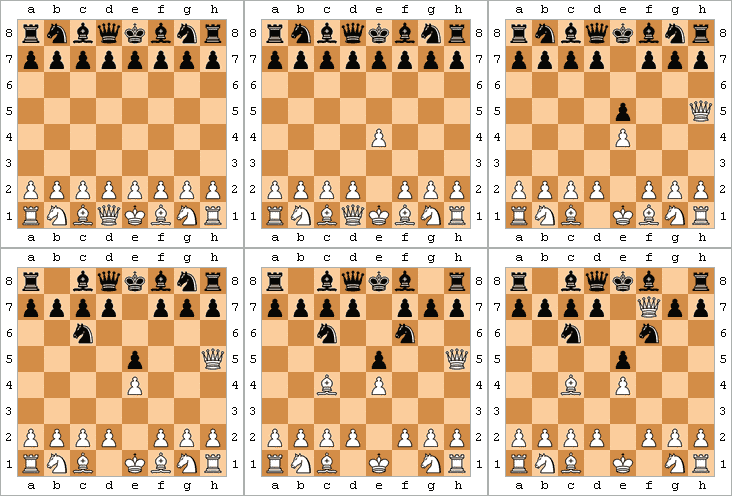 How can sentences containing descriptive and singular terms come to represent the world, without any word-world semantic relation? "If reference is not a relation between a word and some object in the world, then it is completely mysterious how can the use of a name help us pick out anything in the world" says Peter Lupu.
Perhaps it is like chess, and the notation that we use to represent the pieces and the moves. Here is one well-known and simple game:
e4 e5
Qh5?! Nc6
Bc4 Nf6??
Qxf7# 1–0
The major pieces get proper names (K for king, Q for queen). The minor pieces get descriptions ('Nc6' means that the only knight which is available to be moved to c6, is moved there). Play this game at your place, and leave the pieces where they are. I will then play the same game at my place. Then (if we have understood the language of chess correctly), the layout of pieces on my board will represent the layout on yours. So, if your board were the world, and mine was the mental representation, the one would match the other.
Saturday, May 07, 2011
Anselm without ontology
Anselm's attempted proof of the existence of God has often been criticised for the assumption that 'existence is a predicate'. Is that right? I'm going to have a stab here at representing the argument without using the word 'exists'.
The first thing to note is that Anselm gives two arguments, not one. The first is in Proslogion chapter 2, the second is shortly after in chapter 3. Another thing to note is that the argument was written in Latin, of a fiendishly difficult syntax, but I think the 1903 translation by Sidney Norton Deane is actually quite good, though not literal *.
Here is the argument in numbered steps, with minor changes that don't materially impact the sense of the original translation.
1. It is possible to conceive of a being X which cannot be conceived not to exist.
2. Such a being is greater than one which can be conceived not to exist.
3. Suppose that a being Y than which nothing greater can be conceived, can be conceived not to exist.
4. Then Y is not that, than which nothing greater can be conceived.
5. But this is an irreconcilable contradiction.
6. Therefore there is a being than which nothing greater can be conceived to exist, that it cannot even be conceived not to exist.
7. This being is you, O Lord, our God.
The real difficulty is the way that Anselm nests the verb 'conceive'. We are not just conceiving something, we are conceiving something as conceived. I will try and unpack this by representing the argument as a set of 5 steps, all of which fall within the scope of an overall 'conceive' that forms the main verb, and by translating 'x does not exist' as 'nothing is x' (thus removing 'ontology' from 'Anselm' - see the title of this post).
(0) We can conceive of an x and a y such that
(1) we cannot conceive that nothing is x
(2) nothing greater than y can be conceived
(3) we can conceive that nothing is y
(4) x is greater than y
(5) something greater than y can be conceived
Some comments. Step (3) is 'we can conceive that nothing is y' whereas strictly it should be 'nothing is y'. Anselm has "can be conceived not to exist" where the verb 'conceive' is clearly the one belonging in step (0). but then the argument is not valid. My translation is valid, however, if it follows from my conceiving that nothing is y, that by immediate reflection I can conceive of myself conceiving this, and thus conceive that I am conceive that nothing is y. Otherwise, this is a serious flaw in the argument.
For a similar reason, I move from step (4), "[We can conceive that] x is greater than y", to (5) "[We can conceive that] we can conceive that x is greater than y". If these steps are valid, it now follows that we are conceiving a contradiction, i.e. steps (2) and (5) contradict one another. Note, this does not involve an actual contradiction, only the conception or the thought of a contradiction. But this gets Anselm to where he wants, namely to a concept such that it is contradictory to think of it not being instantiated. The verb 'exist' does not appear anywhere, thus translated. The only question is the validity of the move from conceiving of an F, to conceiving of conceiving an F. Is it valid? I don't know.
* For example, he translates Nam potest cogitari esse aliquid, quod non possit cogitari non esse, which is literally, but clumsily "for it is possible that something is thought to be, which could not be thought not to be", as "For, it is possible to conceive of a being which cannot be conceived not to exist". I.e. he converts the passive to an active, and translates 'esse' as 'exist'.
The first thing to note is that Anselm gives two arguments, not one. The first is in Proslogion chapter 2, the second is shortly after in chapter 3. Another thing to note is that the argument was written in Latin, of a fiendishly difficult syntax, but I think the 1903 translation by Sidney Norton Deane is actually quite good, though not literal *.
Here is the argument in numbered steps, with minor changes that don't materially impact the sense of the original translation.
1. It is possible to conceive of a being X which cannot be conceived not to exist.
2. Such a being is greater than one which can be conceived not to exist.
3. Suppose that a being Y than which nothing greater can be conceived, can be conceived not to exist.
4. Then Y is not that, than which nothing greater can be conceived.
5. But this is an irreconcilable contradiction.
6. Therefore there is a being than which nothing greater can be conceived to exist, that it cannot even be conceived not to exist.
7. This being is you, O Lord, our God.
The real difficulty is the way that Anselm nests the verb 'conceive'. We are not just conceiving something, we are conceiving something as conceived. I will try and unpack this by representing the argument as a set of 5 steps, all of which fall within the scope of an overall 'conceive' that forms the main verb, and by translating 'x does not exist' as 'nothing is x' (thus removing 'ontology' from 'Anselm' - see the title of this post).
(0) We can conceive of an x and a y such that
(1) we cannot conceive that nothing is x
(2) nothing greater than y can be conceived
(3) we can conceive that nothing is y
(4) x is greater than y
(5) something greater than y can be conceived
Some comments. Step (3) is 'we can conceive that nothing is y' whereas strictly it should be 'nothing is y'. Anselm has "can be conceived not to exist" where the verb 'conceive' is clearly the one belonging in step (0). but then the argument is not valid. My translation is valid, however, if it follows from my conceiving that nothing is y, that by immediate reflection I can conceive of myself conceiving this, and thus conceive that I am conceive that nothing is y. Otherwise, this is a serious flaw in the argument.
For a similar reason, I move from step (4), "[We can conceive that] x is greater than y", to (5) "[We can conceive that] we can conceive that x is greater than y". If these steps are valid, it now follows that we are conceiving a contradiction, i.e. steps (2) and (5) contradict one another. Note, this does not involve an actual contradiction, only the conception or the thought of a contradiction. But this gets Anselm to where he wants, namely to a concept such that it is contradictory to think of it not being instantiated. The verb 'exist' does not appear anywhere, thus translated. The only question is the validity of the move from conceiving of an F, to conceiving of conceiving an F. Is it valid? I don't know.
* For example, he translates Nam potest cogitari esse aliquid, quod non possit cogitari non esse, which is literally, but clumsily "for it is possible that something is thought to be, which could not be thought not to be", as "For, it is possible to conceive of a being which cannot be conceived not to exist". I.e. he converts the passive to an active, and translates 'esse' as 'exist'.
Wikipedia and Truth in Fiction
I have commented more than once about erroneous information in Wikipedia becoming what Wikipedia calls a ‘reliable source’, and so turning a previously unreliable source into a reliable one. Here is another fascinating example, reported in the Telegraph today.
It began with alterations to the online Wikipedia entry of the art dealer Philip Mould, by some anonymous contributor questioning the importance of “discoveries” and suggesting other dealers had made far more important finds. Then, in October 2009, the same person sent a “press release” to national newspapers, falsely claiming Mould was having an affair with Charlotte Barton, a 42-year-old artist.
These were complete fabrications. The problem for Mould was how to remove the entries. The slanderous allegations were now in the tabloid press, and Wikipedia could now substantiate the same unsourced allegations with 'reliable sources' (yes, Wikipedia does treat tabloids as 'reliable sources' as most Wikipedian editors do not have access to proper libraries, and rely on the internet almost exclusively). So Mould was forced (apparently) into an 'edit war' with Wikipedians who were determined to defend the source.
It began with alterations to the online Wikipedia entry of the art dealer Philip Mould, by some anonymous contributor questioning the importance of “discoveries” and suggesting other dealers had made far more important finds. Then, in October 2009, the same person sent a “press release” to national newspapers, falsely claiming Mould was having an affair with Charlotte Barton, a 42-year-old artist.
These were complete fabrications. The problem for Mould was how to remove the entries. The slanderous allegations were now in the tabloid press, and Wikipedia could now substantiate the same unsourced allegations with 'reliable sources' (yes, Wikipedia does treat tabloids as 'reliable sources' as most Wikipedian editors do not have access to proper libraries, and rely on the internet almost exclusively). So Mould was forced (apparently) into an 'edit war' with Wikipedians who were determined to defend the source.
- 21:06, 11 October 2009 a Wikipedian called Trident13 adds a 'personal life' section.
- 08:51, 12 October 2009 Mould (or someone acting for him) removes it, with the comment 'unnecessary gossip deleted'.
- 10:10, 12 October 2009 some editor called Teapotgeorge adds the material back, with the comment "revert removal of referenced material by coi editor". Yes that's right. Philip Mould cannot remove this slander (a) because Wikipedians imagine the planted story is a reliable source and (b) even more hilariously the subject of the slander has a 'conflict of interest'.
- 17:24, 15 October 2009 Mould attempts to remove it again.
- 17:42, 15 October 2009 Teapotgeorge adds it back, commenting 'You have a conflict of interest please don't remove referenced material take to talk page'.
- 09:50, 16 October 2009 Mould removes once more.
- 12:32, 16 October 2009 Teapotgeorge thankfully gives up but moves the contested material to the 'talk page of the article. But it does not end there.
- 19:38, 9 December 2009 an anonymous IP address changes "The couple separated in May 2009, after Mould started an affair with artist Charlotte "Charlie" Barton." to "The couple separated in May 2009, after Mould started an affair with marriage wrecker Charlotte "Charlie" Barton." ...
- 19:40, 9 December 2009 ... then changes 'marriage wrecker' to 'notorious marriage wrecker'.
- 19:44, 9 December 2009 Teapotgeorge changes 'notorious marriage wrecker' back to 'artist', but comments that he is reverting good faith edits. Good faith?
- 00:51, 10 December 2009 The IP changes back to 'marriage wrecker'.
- 23:46, 6 May 2011 And there, incredibly, it stays for a year and a half, until yesterday when a senior Wikipedia adminstrator 'NewYorkBrad', who for once is not anonymous, being Ira Brad Matetsky of the law firm Ganfer & Shore, LLP in New York, removes it at last, commenting "Section removed. There is evidence of a deliberate plot to defame the subject of this article. For those investigating this misuse of Wikipedia, the content formerly here can be found in the page history".
Friday, May 06, 2011
An apparently serious objection
Peter Lupu makes an apparently serious objection to my view that ‘reference’ is not a relation. (Correctly stated, my view is that ‘refers to’ is a logically intransitive verb – the noun phrase which it takes as a grammatical object has no existential import). He writes “By denying that reference is a relation … [Edward] deprives language from its most important and distinctive way of communicating.” And “To deny that reference is a relation, like Edward professes to do, is to undermine one of the central purposes of language which is to communicate about the world.”
I reply as follows.
1. If any piece of language has an important communication function, we should be able to tell whether it has an important communication function. One of the most important features of communicating with someone is that they should know they are being communicated to. They should also be able to say with reasonable certainty what is being communicated.
2. It follows from this that if non-empty proper names have a vitally important communication function that empty proper names don’t have, then we should know whether or not a name is communicating this vital information, and we should be able to say precisely what the name is communicating.
3. The New Testament contains many proper names. If any of these is non-empty, it is communicating information to us in an important and distinctive way, according to Peter. If it is empty, it is communicating nothing of the sort.
4. Thus (from 2 above) we should be able to tell of that name whether it is communicating information to us in the important and distinctive way which is peculiar to non-empty names. Thus, we should be able to tell which names are empty and which are not.
5. But (assumption) we cannot tell this. We do not know for certain whether the Christ Myth theory is true or not, and thus we don't know whether the name 'Jesus' is empty or not. Thus we do not know whether the name ‘Jesus’ is communicating information to us in the important and distinctive way that is, according to Peter, the peculiar and distinctive mark of a non-empty proper name.
6. I conclude that Peter’s claim is absurd. The information that a proper name communicates to us is exhausted by what it would communicate us even if it had no ‘referent’ at all. The mere fact of the existence of a referent adds no further information to what the name already tells us.
I reply as follows.
1. If any piece of language has an important communication function, we should be able to tell whether it has an important communication function. One of the most important features of communicating with someone is that they should know they are being communicated to. They should also be able to say with reasonable certainty what is being communicated.
2. It follows from this that if non-empty proper names have a vitally important communication function that empty proper names don’t have, then we should know whether or not a name is communicating this vital information, and we should be able to say precisely what the name is communicating.
3. The New Testament contains many proper names. If any of these is non-empty, it is communicating information to us in an important and distinctive way, according to Peter. If it is empty, it is communicating nothing of the sort.
4. Thus (from 2 above) we should be able to tell of that name whether it is communicating information to us in the important and distinctive way which is peculiar to non-empty names. Thus, we should be able to tell which names are empty and which are not.
5. But (assumption) we cannot tell this. We do not know for certain whether the Christ Myth theory is true or not, and thus we don't know whether the name 'Jesus' is empty or not. Thus we do not know whether the name ‘Jesus’ is communicating information to us in the important and distinctive way that is, according to Peter, the peculiar and distinctive mark of a non-empty proper name.
6. I conclude that Peter’s claim is absurd. The information that a proper name communicates to us is exhausted by what it would communicate us even if it had no ‘referent’ at all. The mere fact of the existence of a referent adds no further information to what the name already tells us.
Monday, May 02, 2011
The 'Frodo'-Frodo theory of reference

 I have argued here for a theory of reference that I have called the 'relativity theory' of reference. All reference is semantically indistinguishable from story-relative reference. Just as we can be told which hobbit carried the ring to Mount Doom (Frodo), so we can be told which US President's dog was killed by an assassin (Fido, Abraham Lincoln's dog). History, like stories about hobbits, is just a story (although history, unlike stories about hobbits, is true).
But we could equally call it the 'Frodo'-Frodo theory of reference, after the well-known 'Fido'-Fido theory of meaning. According to 'Fido'-Fido theory, the most economical explanation of the meaning of the proper name 'Fido' is to say that it means, well, Fido. Similarly, according to the 'Frodo'-Frodo theory, the simplest and the most economical explanation of the meaning of the proper name 'Frodo' is to say that it means, well, Frodo. You know, that hobbit. The one who carried the accursed Ring to Mordor.
All philosophical theories come with a curse, of course, just as the Ring did. If there were any simple explanation of a philosophical problem, the problem would have been resolved thousands of years ago. The curse of the 'Frodo'-Frodo theory is Meinong. It seems - though it actually doesn't - to commit us to the existence of non-existent objects.
It doesn't, as I say. "'Frodo' means Frodo" is true, as is "'Frodo' means someone". But this does not entail "someone is such that 'Frodo' means that person". The verb 'means' is logically intransitive. But by this time, you will have said Too long, didn't read. Oh well.
Direct Reference and the Christ Myth theory
 I posted a comment on Vallicella's blog this morning, which this post largely incorporates. According to Vallicella, most direct reference theories of proper names would seem to be committed to four theses which I summarise here.
1. A proper name denotes, designates, refers to, its bearer directly without the mediation of any properties.
2. Proper names are introduced at a 'baptismal ceremony' in which an individual is singled out as the name's bearer.
3. The connection established between name and bearer at the baptism is rigid: the name signifies that bearer in any modal context.
4. The name refers to the bearer only if there is a causal chain extending from S's use of N back to the baptism, where each user to whom the name is transmitted uses it with the intention of referring to the same object as the previous user.
This seems to leave out the most important characteristic of direct reference theory, namely the one expressed by Russell when he says "Whenever the grammatical subject of a proposition can be supposed not to exist without rendering the proposition meaningless, it is plain that the grammatical subject is not a proper name, i.e. not a name directly representing some object" (Principia Mathematica vol i p. 66). As I have argued elsewhere, this makes Frege a direct reference theorist, on one interpretation of Frege - essential reading here is Gareth Evans The Varieties of Reference, chapter 1.
This is a bullet that all direct theorists have to bite. The semantics of empty proper names do not obviously differ from that of non-empty names. For example, I cannot tell whether the 'Christ Myth' theory is true by examining the meaning of the proper name 'Christ'. (According to this theory, there never was such a historical person as Christ, the gospels are complete fiction). But according to a direct reference theorist, the name has no proper meaning at all if it is empty, and thus the semantics of empty proper names are manifestly different from non-empty proper names. Hoc absurdum et incredibile est.
The other features of direct reference theory that Bill mention are either features that follow from the primary claim of direct reference theory - the claim that the meaning is the bearer - or are props for the theory. Rigidity (thesis 3) follows from the meaning-bearer thesis. If the name has a meaning at all, it is because it means that very same object. Thus, in whatever context it has a meaning - and this includes modal contexts - it means that object. Thus it must 'rigidly' refer.
The baptismal requirement (thesis 2) follows from the primary thesis plus Russell's principle - the principle that we cannot make a judgment that is strictly about anything unless we know which object the judgment is about (see Problems of Philosophy p.58). Only when I am directly presented with an object in sense-perception can I truly know which object I am trying to name. We can 'pick out by sight or hearing or touch or otherwise sensibly discriminate' that object (Strawson, Individuals p.18). Perception affords a more 'intimate' or 'direct' relation in which the person stands to the object, in which the subject is en rapport with the object to be named.
The causal chain thesis (4) is a adjunct and buttress, rather than a consequence, of the theory. Given that the one imposing the name by baptism is en rapport with the bearer of the name, and so can use the name in a special way, and so any judgment he makes using that name, involves truly knowing which object the judgment is about, how do we explain the way in which the meaning of the name is communicated to others, who are not en rapport with the name-bearer?
Direct reference theorists introduce causation plus intention to explain this. It is by no means clear how this is to work. Suppose someone witnessed the ministry of Christ on earth, and so stood in an intimate and direct relation to the person of Christ. Then Christ died, rose, appeared to certain people, and then the witness sat down and wrote a gospel. The gospel is intended to communicate Christ's ministry and his death and resurrection to those who did not witness any of these events, and who had no such rapport with his person. How then can the name 'Christ' have the same meaning for one who was not a witness, as for one who was? In the understanding of the witness, 'Christ' has its baptismal meaning. For one who grasps this meaning, it is impossible that Christ should not exist. It would be like saying "this person here [pointing to Peter] does not exist". But in the understanding of one who was not a witness, the gospel is semantically indistinguishable from a mere story. One can read that story and reasonably ask whether Christ existed at all. Semantic analysis of the gospel will not resolve the 'Christ myth' controversy.
So it is clear that, even if the writer of the gospel is using the name 'Christ' in the special meaning that requires rapport with the person of Christ, and even if he uses it with the intention of referring to that person, he cannot communicate that special, direct meaning to the non-witness. Otherwise, as I say, the Christ myth controversy would not be a controversy.
In conclusion, the primary distinguishing characteristic of direct reference theory is that the meaning of a proper name is its bearer, i.e. that the bearer must exist in order for the name to have a meaning at all. The theses that Bill mentions are either logical consequences of this primary thesis, or are mere props, futile attempts to save it.
Sunday, May 01, 2011
Too long, didn't read
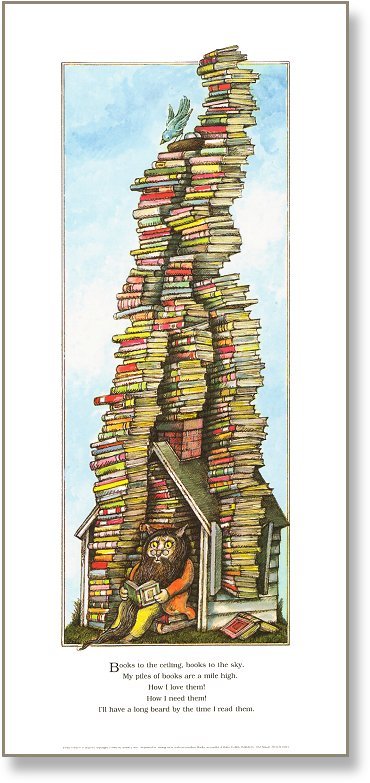 There is no greater enemy of theory that 'tl;dr' (Internet slang for 'too long: didn't read'). Schopenhauer wrote (I can't remember where) that the whole of his enormous work The World as Will and Representation was expressing a single proposition, presumably one that could not be expressed by any shorter proposition. That is bad. You should always have some shorter proposition up your sleeve for the day you are caught on a desert island and some brutish fellow requires you to defend your theory. What would Schopenhauer have done if marooned without his innumerable tomes?
 So here is my 'short', three-part defence of the story-relative theory of reference which I have been discussing throughout this year in this blog (one day I will put all this into a book, but not yet).
(1) We can tell 'which' character is being talked about in a story. War and Peace has many hundreds of minor characters but we can always (assuming we have paid attention) tell which character the author is talking about or 'referring to'.
(2) There is no obvious difference between the semantics of a made-up story, and the semantics of a historical account which is perfectly true. E.g. we cannot tell from what is said in the Old Testament whether any of the characters really existed or not. Yet we can tell Adam from Eve, Cain from Abel, Moses from Isaiah and so on. Whatever explains reference in a story, also explains reference-in-history.
(3) All the objections which argue against proper names being concealed descriptions, also apply against proper names that are used in a story. Whatever features or accidents we ascribe to a character in a story, we can deny of that character using the proper name for that character, for example.
Which of these are you going to deny? Can Tolkien not tell us which hobbit threw the ring into Mount Doom? Is there any obvious semantic difference between a narrative which might be true (the Old Testament) and one which obviously isn't true (The Aeneid)? Is there any property signified by a fictional name except: being that very character?
There is more you could overlay on the theory. You would want to distinguish it from a Meinongian theory of reference, and thus defend it against objections to such theories. We would do this by the concept of the 'logically intransitive verb' which I described elsewhere. You would want to develop some account of the 'true logical form' of logical intransitivity. You would want to develop a deeper account of the distinction between singular and general terms. All this can be done, but it take time. And also may be just too long to read. We live in the barbaric world of the internet.
Reference and Bedeutung
William Vallicella takes me to task here for saying 'referential' when 'directly referential' was meant. This is a good point, as the English word 'reference' has a variety of meanings, even in philosophical usage. Nonetheless, it gets its philosophical meaning from the translation of Frege's work in German "Über Sinn und Bedeutung" as "On Sense and Reference". The German word Bedeutung means meaning or significance.
Frege thought that the semantic power of an expression consists in its being associated with an extra-linguistic item. Even a whole sentence has a Bedeutung or reference, namely one or the other of the two Platonic objects 'The True' or 'The False'. Thus the Bedeutung or Reference or Signification of a complete sentence consists in its being True or False.
According to him, the semantics of the sentence is compositional. Each significant expression has a semantic value which affects the truth-value of the sentence in which it occurs. The semantic power of a a concept expression such as '- is wise' is to signify a Concept, a Platonic extra-linguistic entity which maps all and only wise objects to the value 'True'. The semantic value of a singular term is also an extra-linguistic item, an Object such as Socrates. Thus the proper name 'Socrates' has the role of introducing an object to the concept-expression '- is wise', thereby determining the Truth Value of the sentence 'Socrates is wise'.
If a proper name (eg. 'Bilbo') fails to be associated with an extra-linguistic item, it fails to introduce an Object to the concept-expression with which it is combined. As a consequence, the resulting sentence will (according to Frege) lack a Truth-value. It will signify neither the True nor the False and thus, since the signification of the sentence consists in its being True or False, will lack a signification. Thus Frege writes
Frege thought that the semantic power of an expression consists in its being associated with an extra-linguistic item. Even a whole sentence has a Bedeutung or reference, namely one or the other of the two Platonic objects 'The True' or 'The False'. Thus the Bedeutung or Reference or Signification of a complete sentence consists in its being True or False.
According to him, the semantics of the sentence is compositional. Each significant expression has a semantic value which affects the truth-value of the sentence in which it occurs. The semantic power of a a concept expression such as '- is wise' is to signify a Concept, a Platonic extra-linguistic entity which maps all and only wise objects to the value 'True'. The semantic value of a singular term is also an extra-linguistic item, an Object such as Socrates. Thus the proper name 'Socrates' has the role of introducing an object to the concept-expression '- is wise', thereby determining the Truth Value of the sentence 'Socrates is wise'.
If a proper name (eg. 'Bilbo') fails to be associated with an extra-linguistic item, it fails to introduce an Object to the concept-expression with which it is combined. As a consequence, the resulting sentence will (according to Frege) lack a Truth-value. It will signify neither the True nor the False and thus, since the signification of the sentence consists in its being True or False, will lack a signification. Thus Frege writes
A sentence can be true or untrue only if it is an expression for a thought. The sentence "Leo Sachse is a man" is the expression of a thought only if 'Leo Sachse' designates something. And so too the sentence "this table is round" is the expression of a thought only if the words 'this table' are not empty sounds but designate something specific for me" (Posthumous Writings, p.174).And again:
Names that fail to fulfil the usual role of a proper name, which is to name something, may be called mock proper names ... Instead of speaking about fiction we could speak of 'mock thoughts'. Thus, if the sense of an assertoric sentence is not true, it is either false or fictitious, and it will generally be the latter if it contains a mock proper name. Assertions in fiction are not to be taken seriously, they are only mock assertions. Even the thoughts are not to be taken seriously as in the sciences: they are only mock thoughts ... The logician does not have to bother with mock thoughts, just as a physicist, who sets out to investigate thunder, will not pay any attention to stage-thunder. When we speak of thoughts in what folows we mean thoughts proper, thoughts that are either true or false. (Posthumous Writings, p. 130, my emphasis).In summary. The philosophical word 'reference' derives its meaning as a translation of Frege's word Bedeutung, meaning signification. The signification of a complete sentence consists in its signifying the True or the False. Thus, on his account, a fictional name, which fails to introduce any Object to the Concept-expression to which it is adjoined in a complete sentence, and thus cannot contribute to the Truth value of the sentence, cannot have a signification either.
Saturday, April 30, 2011
The Monologion
Anselm's Monologion - all 80 chapters of it - is now in the Logic Museum, in parallel Latin English. Ockham frequently refers to this work in the Summa Logicae.
On the reference of 'Sherlock Holmes'

 Bill asks here "What makes my utterance of 'Socrates' denote Socrates rather than someone or something else?"
And I ask "What makes my utterance of 'Sherlock Holmes' refer to Holmes rather than someone or something else?" It's not simple. There actually is a person called 'Sherlock Holmes' who is a minister of the church living in Massachusetts. There is an article about him in the Sherlock Holmes society journal here. So I could use the name to refer to him, as that article does. Yet a character of the same name appears in the novel The Seven-Per-Cent Solution by Nicholas Meyer, but in this case it is made clear that the character is the same person as the one Conan Doyle wrote about. Meyer's book is an extension of the 'Holmes mythos'. And also of the Ruritania mythos - in the book, Holmes meets Rudolf Rassendyll, hero of Prisoner of Zenda.
So we can use the name of a fictional character either (i) to refer to the character in a 'textual criticism' context (ii) to write more fiction in the same genre or mythos, (iii) to refer to a real person who happens to share the same name. What a tangled net, no wonder so many clever people have been ensnared by it.
Thursday, April 28, 2011
The God of Christianity and the God of Islam
Vallicella has a nice post here about whether the God of Christianity and the God of Islam are the same God. He points out that if reference is mediated by sense, and that if the sense of 'God of Islam' is D1: 'the unique x such that x is omnipotent, omniscient, omnibenevolent, created the world ex nihilo and is unitarian', and if the sense of 'God of Christianity' is D2: 'the unique x such that x is omnipotent, omniscient, omnibenevolent, created the world ex nihilo and is triune', then:
But now suppose that both religions have the same ‘core’ holy book B, which refers to one god by name G, but which gives no uniquely defining property for that god. However, at some point in the past there was a disagreement over some heresy, and each religion now has a different supplementary holy book – B1 in the case of religion A1, and B2 in the case of religion A2. It is from these supplementary texts that the disagreement over the uniquely defining properties F1 and F2 arises. But both texts refer to god using the same name G as the core book B. Thus the intended or purported reference of G is the same for both competing religions. The disagreement is not about the identity of the purported referents of G – for these have to be one and the same being – but rather the properties F1 and F2. Both religions agree they are worshipping one and the same god, but they disagree about whether he has the uniquely defining F1 (in the case of A1) or the uniquely defining F2 (in the case of A2).
Something like this clearly holds for Judaism and Christianity. The purported referent of ‘YHWH’ is the same for both Christians and Jews. That is a logical conclusion from the semantics of the Old and New Testament names. You will not understand the New Testament unless you understand that the names 'God' and 'Lord' are meant to refer to the intended referent of 'YHWH' in the Old Testament. But the properties are different. Christians hold that YHWH had a son, who is one and the same god as YHWH, but a different person. Jews do not hold this belief. So a description theory has the god of the Jews and the god of the Christians as being numerically different. But a reference theory (which holds that identity is determined by intended identity or intended referent) has them as being the same.
I do not know much about Islam, but I believe that the Islamic holy books are the records which Muslims believe were dictated by God to various Islamic prophets throughout the history of mankind. I.e. Moses (according to Muslims) was an Islamic prophet. Since Christians, Jews and Muslims agree that YHWH gave the laws to Moses, the intended reference of ‘YHWH’ is the same for all. I.e. if YHWH exists, all three religions are referring to him, even though they disagree fundamentally, and bitterly, about his properties. E.g. Christians believe YHWH he has a son in Jesus. Muslims believe he has a prophet in Jesus, Jews disagree with both of these things, believing Jesus to have been a heretic and a blasphemer, for which reason he was executed.
It is easy to see that no one entity can satisfy both (D1) and (D2). So if reference is routed through sense, then Christian and Muslim cannot be referring to the same being. Indeed, one of them is not succeeding in referring at all. For if God is triune, nothing in reality answers tothe Muslim's conception of God. And if God is unitarian, then nothing in reality answers to the Christian conception.His examples bring out, in my view, the problem with description theories of singular reference. Suppose that, according to religion A1, there is one god who satisfies the uniquely applying description F1. And suppose that, according to religion A2, there is one god who satisfies the uniquely applying description F2. And suppose, for sake of argument, that F1 and F2 are contraries. Nothing can be both F1 and F2 (Bill's example is 'unitarian' and 'triune'. Then if religion A1 is correct, there is exactly one F1 and (from the logical properties of F1) there can be no being that satisfies F2. Conversely, if religion A2 is correct, there is exactly one F2, and there can be no being that is F1. According to a description theory, neither god can be identical with the other, if either exists.
But now suppose that both religions have the same ‘core’ holy book B, which refers to one god by name G, but which gives no uniquely defining property for that god. However, at some point in the past there was a disagreement over some heresy, and each religion now has a different supplementary holy book – B1 in the case of religion A1, and B2 in the case of religion A2. It is from these supplementary texts that the disagreement over the uniquely defining properties F1 and F2 arises. But both texts refer to god using the same name G as the core book B. Thus the intended or purported reference of G is the same for both competing religions. The disagreement is not about the identity of the purported referents of G – for these have to be one and the same being – but rather the properties F1 and F2. Both religions agree they are worshipping one and the same god, but they disagree about whether he has the uniquely defining F1 (in the case of A1) or the uniquely defining F2 (in the case of A2).
Something like this clearly holds for Judaism and Christianity. The purported referent of ‘YHWH’ is the same for both Christians and Jews. That is a logical conclusion from the semantics of the Old and New Testament names. You will not understand the New Testament unless you understand that the names 'God' and 'Lord' are meant to refer to the intended referent of 'YHWH' in the Old Testament. But the properties are different. Christians hold that YHWH had a son, who is one and the same god as YHWH, but a different person. Jews do not hold this belief. So a description theory has the god of the Jews and the god of the Christians as being numerically different. But a reference theory (which holds that identity is determined by intended identity or intended referent) has them as being the same.
I do not know much about Islam, but I believe that the Islamic holy books are the records which Muslims believe were dictated by God to various Islamic prophets throughout the history of mankind. I.e. Moses (according to Muslims) was an Islamic prophet. Since Christians, Jews and Muslims agree that YHWH gave the laws to Moses, the intended reference of ‘YHWH’ is the same for all. I.e. if YHWH exists, all three religions are referring to him, even though they disagree fundamentally, and bitterly, about his properties. E.g. Christians believe YHWH he has a son in Jesus. Muslims believe he has a prophet in Jesus, Jews disagree with both of these things, believing Jesus to have been a heretic and a blasphemer, for which reason he was executed.
Wednesday, April 27, 2011
Gospel truth
In my last post, I mentioned two fundamental differences between the account of fiction I have defended here, and the account given by Peter van Inwagen in "Creatures of fiction". The first is that, according to me, sentences in fiction have a truth value. They are typically false (although works of fiction may contain many true statements, such as that Napoleon was short, that Paris is a city in France, that Baker street is in London etc). The second is that fictional names refer. Van Inwagen, by contrast, holds that (i) sentences in fiction typically assert nothing at at all and (ii) fictional names do not refer.
Taking the first point first. Van Inwagen's position is essentially the neo-Fregean view of assertion, namely that the same thought or proposition may occur now asserted, now unasserted, that I have criticised in many places, particularly here, arguing that assertion is part of the semantics of a sentence, and that every complete sentence (i.e. one that is not a subordinate or noun clause) can be analysed into a sign for the content of the sentence - that which it states or expresses, usually signified by a 'that' clause, and a sign for assertion or denial. Thus "Snow is white" = "It is the case / that snow is white". If this is correct, then even fictional sentences contain an assertoric component, and hence are capable of truth or falsity, independent of what the narrator means or intends when he or she utters them. This is exactly what Van Inwagen denies, and it is, of course, why he calls sentences vehicles of assertion.
The same view is defended by Alvin Plantinga (The Nature of Necessity, Oxford, 1974, Ch. VIII, pp. 153-163 especially), who cites a famous passage by the English poet Sir Philip Sidney (1554-1586).
Someone who is not a Biblical fundamentalist must deal with the possibility that some or all of the events recounted in the Gospel are not literally true. If so, then according to Inwagen’s neo-Fregean view of assertion, one who recounts the Gospels is not asserting anything, and is not saying anything true or false. Clearly not: the fundamentalist, for one, will strenuously defend the literal truth of everything that is stated there. The ‘truth’ of the Resurrection is fundamental to Christian belief, and is even something a Christian has to publicly state they believe in.
Nor can Van Inwagen exclude such texts from his account. For his account is designed to explain the truth and falsity of statements of textual criticism, in which Biblical criticism must be included. For example, in “Discipleship and minor characters in mark's gospel” Joel Williams writes.
I will discuss the second point about 'reference' later.
Taking the first point first. Van Inwagen's position is essentially the neo-Fregean view of assertion, namely that the same thought or proposition may occur now asserted, now unasserted, that I have criticised in many places, particularly here, arguing that assertion is part of the semantics of a sentence, and that every complete sentence (i.e. one that is not a subordinate or noun clause) can be analysed into a sign for the content of the sentence - that which it states or expresses, usually signified by a 'that' clause, and a sign for assertion or denial. Thus "Snow is white" = "It is the case / that snow is white". If this is correct, then even fictional sentences contain an assertoric component, and hence are capable of truth or falsity, independent of what the narrator means or intends when he or she utters them. This is exactly what Van Inwagen denies, and it is, of course, why he calls sentences vehicles of assertion.
The same view is defended by Alvin Plantinga (The Nature of Necessity, Oxford, 1974, Ch. VIII, pp. 153-163 especially), who cites a famous passage by the English poet Sir Philip Sidney (1554-1586).
Now for the poet, he nothing affirmeth, and therefore never lieth. For, as I take it, to lie is to affirm that to be true which is false; so as the other artists, and especially the historian, affirming many things, can, in the cloudy knowledge of mankind, hardly escape from many lies. But the poet, as I said before, never affirmeth. The poet never maketh any circles about your imagination, to conjure you to believe for true what he writeth. He citeth not authorities of other histories, but even for his entry calleth the sweet Muses to inspire into him a good invention; in troth, not laboring to tell you what is or is not, but what should or should not be. And therefore though he recount things not true, yet because he telleth them not for true he lieth not; without we will say that Nathan lied in his speech, before alleged, to David; which, as a wicked man durst scarce say, so think I none so simple would say that Aesop lied in the tales of his beasts; for who thinketh that Aesop wrote it for actually true, were well worthy to have his name chronicled among the beasts he writeth of.This is not right. For it is not true, as Sidney implies, that there is absolutely no gap between saying something false, and lying. There are at least two things in between. The dictionary definition of ‘to lie’ is ‘to utter something that is false with the intention to deceive’. Thus (1) in the case of stories, the narrator utters something he knows to be false, but with no intention to deceive. There is a compact between the narrator and his audience. The audience knows that these are falsehoods, the narrator knows that they know this, and both sides agree the same. This does not change the fact that the things said are (typically) falsehoods. And (2) in many cases a person uttering falsehoods does not know they are false, but rather believes sincerely in their truth, and so does not intend to deceive either. For example, a story about some miracle that (we will assume) cannot be true, but which the teller genuinely and sincerely and believes, and which, to paraphrase Sidney “he telleth for true”.
Someone who is not a Biblical fundamentalist must deal with the possibility that some or all of the events recounted in the Gospel are not literally true. If so, then according to Inwagen’s neo-Fregean view of assertion, one who recounts the Gospels is not asserting anything, and is not saying anything true or false. Clearly not: the fundamentalist, for one, will strenuously defend the literal truth of everything that is stated there. The ‘truth’ of the Resurrection is fundamental to Christian belief, and is even something a Christian has to publicly state they believe in.
Nor can Van Inwagen exclude such texts from his account. For his account is designed to explain the truth and falsity of statements of textual criticism, in which Biblical criticism must be included. For example, in “Discipleship and minor characters in mark's gospel” Joel Williams writes.
The main character groups in Mark's Gospel are the disciples, the opponents of Jesus, and the crowd. In addition to these groups, a number of individual characters are included in Mark's narrative. Some of them, such as Andrew or Peter, are disciples, while others, such as the high priest or Pilate, oppose Jesus. Also a number of minor characters function neither as Jesus' disciples nor as His opponents.The statements are clearly true, and they include the sort of quantification (“some of them … others…”) that Inwagen’s account is designed to explain. But they are inconsistent with one of his key assumptions, which is that ‘textual criticism’ statements are vehicles of assertion, whereas the sentences in the texts they are criticising are not.
I will discuss the second point about 'reference' later.
Monday, April 25, 2011
Vehicles of assertion
I read Creatures of Fiction* more carefully over the break, and I now see I have fundamentally misunderstood Inwagen's position. I had assumed that he saw no fundamental difference between sentences like this
Thus the two positions that I have defended in many places here, namely (a) that sentences in fiction are the vehicles of assertion, and that what is asserted is mostly false and (b) that proper names refer even in a fictional context, are inconsistent with Van Inwagen's position. For he says in the passage cited above that an author of fiction asserts nothing, and he says that there is no attempt at reference. And later (p.307) he says that we can only denote fictional characters, by means of descriptions which are true only of them.
* Page references that follow are to American Philosophical Quarterly 14, October 1977.
(i) She was a fat old woman, this Mrs. Gamp, with a husky voice and a moist eye, which she had a remarkable power of turning up, and only showing the showing the white of it (Martin Chuzzlewit, XIX)and sentences like this:
(ii) Mrs. Sarah Gamp was, four-and-twenty years ago, a fair representation of the hired attendant on the poor in sickness (From Dickens's preface to an 1867 edition of Martin Chuzzlewit)The first is a sentence from the novel itself, and so belongs in English literature. The second is from an essay about the novel, and so belongs in English literary criticism. It turns out (p. 301) that while Van Inwagen regards the second type of sentence, i.e. the sentence belonging to the genre of literary criticism, as being the vehicle of assertion and thus capable of truth and falsity (the second one is probably true, for example), he does not regard the first type as being a vehicle of assertion. He writes:
There is no point in debating what sort of thing Dickens was writing about when he wrote (i) or debating what sort of fact or proposition he was asserting, since he was not writing about anything and was asserting nothing. Sentence (i) does not represent an attempt at reference or description.He mentions (in a footnote) that this is an important point and that the reader who does not concede it will get little out of reading further. He says that the arguments establishing it will be found in Alvin Plantinga, The Nature of Necessity (Oxford, 1974) Ch. VIII, pp. 153-163 especially, and J. O. Urmson, "Fiction," American Philosophical Quarterly, vol. 4 13 (1976), pp. 153-157. Much of what Plantinga says is visible on limited preview here.
Thus the two positions that I have defended in many places here, namely (a) that sentences in fiction are the vehicles of assertion, and that what is asserted is mostly false and (b) that proper names refer even in a fictional context, are inconsistent with Van Inwagen's position. For he says in the passage cited above that an author of fiction asserts nothing, and he says that there is no attempt at reference. And later (p.307) he says that we can only denote fictional characters, by means of descriptions which are true only of them.
How it is we are able to use the proper name "Mrs. Gamp" to refer to a certain creature of fiction ? Normally, an object gets a proper name by being dubbed or baptized. But no one ever dubbed or baptized the main satiric villainess of Martin Chuzzlewit "Mrs. Gamp."There is no corresponding problem about how it is this creature of fiction is denoted by "the main satiric villainess of Martin Chuzzlewit," for this is a quite straightforward definite description that names what we also call "Mrs. Gamp" for the same reason that "the tallest structure in Paris in 1905" names what we also call "the Eiffel Tower" : in each of these cases, a definite description denotes a certain object in virtue of a certain property that that object has uniquely. I think that if we are to have a satisfactory theory of how it is that we manage to refer to particular creatures of fiction, this theory will have to treat such descriptions as "the main satiric villainess" as the primary means of reference to these objects, and proper names as a secondary (though more common) means of reference.In subsequent posts, I will clarify and add to my earlier views on the two positions (a) and (b) above.
* Page references that follow are to American Philosophical Quarterly 14, October 1977.
Saturday, April 23, 2011
More Holmes
There's a in-some-way-similar discussion about fiction over at Peter Smith's residence. In this case, in relation to the truth of mathematical statement and the, er, 'ontological status' of numbers and thingies. I've only just caught hold of it, and now Easter looms.
5 Myths About the 'Information Age'
A lovely article here.
"We have entered the information age." This announcement is usually intoned solemnly, as if information did not exist in other ages. But every age is an age of information, each in its own way and according to the media available at the time. No one would deny that the modes of communication are changing rapidly, perhaps as rapidly as in Gutenberg's day, but it is misleading to construe that change as unprecedented.And see my own ramblings, e.g. here.
Thursday, April 21, 2011
To have and to hold
Thanks to the link that Peter van Inwagen sent, I was able to look at his paper “Creatures of Fiction”* which has a much clearer explanation and justification of his thesis that fictional characters can be such and such without having the property of being such and such. Caution: the paper was written in 1977, 34 years ago, and I don’t know if van Inwagen still holds the views expressed there.
The distinction is motivated by the problem of sentences such as “Some fictional characters are witches”. Van Inwagen holds that such sentences are true, and because he is an anti-Meinongian (or rather, as I have argued, because he holds Brentano’s Thesis), he holds that it is equivalent to ‘Fictional characters that are witches exist’, and so implies ‘Witches exist’. But witches don’t exist. Inwagen gets round the difficulty by asserting that predication has different senses. “Witches don’t exist’ has the conventional sense, meaning that nothing has the property of being a witch. But “Some fictional characters are witches” has a non-standard sense, and does not imply that anything does have the property of being a witch, and so is consistent with "witches don’t exist".
He justifies this by an argument from analogy. His example is a Cartesian who holds that people are immaterial substances. Hence Jake, who is a person, is an immaterial substance. But the sentence “Jake is 6 feet tall” can’t be literally true, for an immaterial substance is unextended, and can’t be 6 feet tall. The Cartesian can get round this by claiming that in ordinary speech we often say "is" when strictly speaking we should say "animates a body that is": the predicate ‘is F’, when predicated of a person, really and strictly means "animates a body that is F". Thus what looks like predication in ordinary speech is not always predication. And so “Alexandra Medford is a witch”, said of the witch played by Cher in The Witches of Eastwick, does not imply that anyone has the property of being a witch. Thus (as I interpret Inwagen) there is no inconsistency between his view that Alexandra Medford exists, but that witches do not, for the following syllogism is invalid:
No one is a witch
Alexandra Medford is a witch
No one is Alexandra Medford
It is invalid because ‘is’ is equivocal in the major and the minor. In the major, it means ‘nothing has the property of being a witch’. In the minor, it is not the ‘is’ of predication, and thus is not equivalent to “Alexandra Medford has the property of being a witch”. Fallacy of equivocation. Thus we can consistently claim that Alexandra Medford exists, i.e. that someone is Alexandra Medford, that she is a witch, although she does not have the property of being a witch, and that no one has the property of being a witch.
My only reply to this (although I am sure there will be more to say), is to invoke Ockham’s other razor, which I discussed some time ago. To one who claims that the verb 'to be' is ambiguous in certain arguments, he objects that this is completely irrational, he says "for it amounts to destroying every argument form. For whenever it pleases me, I will say that 'to be' is equivocal in the premisses, and I will ascribe at will a fallacy of equivocation to every syllogism".
* American Philosophical Quarterly, Volume 14, Number 4, October 1977
The distinction is motivated by the problem of sentences such as “Some fictional characters are witches”. Van Inwagen holds that such sentences are true, and because he is an anti-Meinongian (or rather, as I have argued, because he holds Brentano’s Thesis), he holds that it is equivalent to ‘Fictional characters that are witches exist’, and so implies ‘Witches exist’. But witches don’t exist. Inwagen gets round the difficulty by asserting that predication has different senses. “Witches don’t exist’ has the conventional sense, meaning that nothing has the property of being a witch. But “Some fictional characters are witches” has a non-standard sense, and does not imply that anything does have the property of being a witch, and so is consistent with "witches don’t exist".
He justifies this by an argument from analogy. His example is a Cartesian who holds that people are immaterial substances. Hence Jake, who is a person, is an immaterial substance. But the sentence “Jake is 6 feet tall” can’t be literally true, for an immaterial substance is unextended, and can’t be 6 feet tall. The Cartesian can get round this by claiming that in ordinary speech we often say "is" when strictly speaking we should say "animates a body that is": the predicate ‘is F’, when predicated of a person, really and strictly means "animates a body that is F". Thus what looks like predication in ordinary speech is not always predication. And so “Alexandra Medford is a witch”, said of the witch played by Cher in The Witches of Eastwick, does not imply that anyone has the property of being a witch. Thus (as I interpret Inwagen) there is no inconsistency between his view that Alexandra Medford exists, but that witches do not, for the following syllogism is invalid:
No one is a witch
Alexandra Medford is a witch
No one is Alexandra Medford
It is invalid because ‘is’ is equivocal in the major and the minor. In the major, it means ‘nothing has the property of being a witch’. In the minor, it is not the ‘is’ of predication, and thus is not equivalent to “Alexandra Medford has the property of being a witch”. Fallacy of equivocation. Thus we can consistently claim that Alexandra Medford exists, i.e. that someone is Alexandra Medford, that she is a witch, although she does not have the property of being a witch, and that no one has the property of being a witch.
My only reply to this (although I am sure there will be more to say), is to invoke Ockham’s other razor, which I discussed some time ago. To one who claims that the verb 'to be' is ambiguous in certain arguments, he objects that this is completely irrational, he says "for it amounts to destroying every argument form. For whenever it pleases me, I will say that 'to be' is equivocal in the premisses, and I will ascribe at will a fallacy of equivocation to every syllogism".
* American Philosophical Quarterly, Volume 14, Number 4, October 1977
More papers by van Inwagen
Peter writes to me to say that a lot of his papers are online here. His most comprehensive paper on fictional entities is in "Existence, Ontological Commitment, and Fictional Entities.", which is not on that site. But the site does contain two older papers: "Fiction and Metaphysics" and "Creatures of Fiction."
Wednesday, April 20, 2011
Van Inwagen on existence
I had a brief correspondence with Van Inwagen earlier this week, but he came up with nothing that resolved some of my other puzzles about his theory. Here is one. From what he says, Inwagen seems committed to the following:
(1) 'Some x is A' is equivalent to 'some x-that-is-A exists'.
(2) 'Holmes does not exist' is equivalent to 'no one has all the properties Sherlock Holmes holds'.
(3) Someone, namely Holmes, holds all the properties held by Sherlock Holmes
(4) No one has all the properties held by Holmes.
But this leads to a contradiction, as follows.
(5) Holmes does not exist (from 2, 4).
(6) Someone, namely Holmes, who holds all the properties held by Sherlock Holmes, exists (from 1, 3).
(7) Holmes exists (from 6, elimination)
(8) Contradiction (5, 7)
Spelling it out. Van Inwagen is trying to get over the problem of 'someone' having the properties ascribed to Holmes, through his distinction between 'having' and 'holding'. No one has the properties that Holmes holds, and so Holmes does not exist. But this does not evade the problem. By the very same reasoning, someone holds the properties that Holmes does not have. And there is still 'someone', and so Holmes does exist. Van Inwagen can evade this by dropping his commitment to the equivalence of 'some thing' with 'some existing thing'. But that would commit him to the variety of Meinongianism to which he is so fundamentally opposed.
(1) 'Some x is A' is equivalent to 'some x-that-is-A exists'.
(2) 'Holmes does not exist' is equivalent to 'no one has all the properties Sherlock Holmes holds'.
(3) Someone, namely Holmes, holds all the properties held by Sherlock Holmes
(4) No one has all the properties held by Holmes.
But this leads to a contradiction, as follows.
(5) Holmes does not exist (from 2, 4).
(6) Someone, namely Holmes, who holds all the properties held by Sherlock Holmes, exists (from 1, 3).
(7) Holmes exists (from 6, elimination)
(8) Contradiction (5, 7)
Spelling it out. Van Inwagen is trying to get over the problem of 'someone' having the properties ascribed to Holmes, through his distinction between 'having' and 'holding'. No one has the properties that Holmes holds, and so Holmes does not exist. But this does not evade the problem. By the very same reasoning, someone holds the properties that Holmes does not have. And there is still 'someone', and so Holmes does exist. Van Inwagen can evade this by dropping his commitment to the equivalence of 'some thing' with 'some existing thing'. But that would commit him to the variety of Meinongianism to which he is so fundamentally opposed.
Sunday, April 17, 2011
More link testing
Link 1 and link 2 posted yesterday were immediately indexed by Google. So let's try with the original link, to see if the power of Blogger will cause it to be recognised. (One advantage of Blogger is that any post, and hence any link, is instantaneously processed by Google*).
Also, a link to a copy of De Civitate Dei.
*As proof of this, I Googled the words "were immediately indexed by Google", within seconds of posting this, and lo, this post came up in the search.
Also, a link to a copy of De Civitate Dei.
*As proof of this, I Googled the words "were immediately indexed by Google", within seconds of posting this, and lo, this post came up in the search.
More facts about fiction
There is a nice preprint of a paper here by Inwagen where he discusses different theories of being, and particularly the 'neo-Meinongian' theories such as those held by Terry Parsons and Colin Mcginn. He writes
I also found a paper by Amie Thomasson about fictional entities. She mentions, but rejects, the explanation of discourse about fiction by the use of a 'fiction operator'.
When I say that everything exists and the neo-Meinongian denies that everything exists, we’re not talking past each another—not, at any rate, because we mean different things by ‘everything’. It is precisely because the neo-Meinongian knows that I mean just what he does by ‘everything’ that he indignantly rises to dispute my contention that everything exists.This is not a hundred miles from what I argued here. Maverick philosopher also discusses Inwagen's paper here, though I confess I don't understand his objections to it. The force of Inwagen's paper is neo-Meinongianism is a theory about the meaning of 'exists', rather than a theory about what exists.
I also found a paper by Amie Thomasson about fictional entities. She mentions, but rejects, the explanation of discourse about fiction by the use of a 'fiction operator'.
Internal discourse by readers can still be held to be true even though it involves non-referring names, since these claims are plausibly held to be implicitly prefixed with a fiction operator, where “According to the fiction, Holmes solved his first mystery in his college years” may be true even if the simple claim “Holmes solved his first mystery in his college years” would be false. Cross-fictional statements can be handled similarly by taking them to fall in the context of an ‘agglomerative’ story operator that appeals to the total content of the relevant stories, taken together, e.g. “According to (Anna Karenina and Madame Bovary [taken agglomeratively]), Anna Karenina was more intelligent than Emma Bovary”Fictional operator theories are attractive, and I will try to discuss them next week.
Friday, April 15, 2011
Logic Museum links
Work so far on the Ockham translation:
Chapters 11-17, including Ockham's arguments against the reality of universals, to follow one day.
Also there is Book I question I of the Summa on its own. This is part of a test to understand why Google does not index certain pages, together with a modified translation (in case Google is ignoring it because on other sites).
| Chapter or section | Description |
|---|---|
| Index | The division of terms |
| Book I chapters 1-4 | The division of terms |
| Book I chapters 5-9 | Concrete and abstract terms |
| Book I chapter 10 | The definition of 'connotative' and 'absolute' terms |
| Book II chapter 7 | Truth conditions of past and future tense propositions |
| Book II chapters 12 & 14 | Negative and non-referring propositions |
| Book III.2 chapters 4-7 | Of the division of propositions required for demonstration |
Chapters 11-17, including Ockham's arguments against the reality of universals, to follow one day.
Also there is Book I question I of the Summa on its own. This is part of a test to understand why Google does not index certain pages, together with a modified translation (in case Google is ignoring it because on other sites).
Thursday, April 14, 2011
Ghost writing in Latin
 Holiday time, so I am amusing myself by reading the ghost stories of M.R. James again. As Wikipedia correctly notes, James' protagonists are usually naive scholarly gentlemen, who through the discovery of some antiquarian object attract (generally unwelcome and unpleasant) attention from the other side of the grave. Naturally there is plenty of Latin. James went to Eton College and the King's College Cambridge, where he began a distinguished academic career, becoming Director of the Fitzwilliam museum, then Provost of King's. He is well-known to medievalists through his Descriptive Catalogue of the manuscripts in the Library of Gonville and Caius College.
Here is some of his made-up Latin (with his own translation) from the story "The Treasure of Abbott Thomas".
| Latin | English |
|---|---|
| Verum usque in praesentem diem multa garriunt inter se Canonici de abscondito quodam istius Abbatis Thomae thesauro, quem saepe, quanquam ahduc incassum, quaesiverunt Steinfeldenses. | Up to the present day there is much gossip among the Canons about a certain hidden treasure of this Abbot Thomas, for which those of Steinfeld have often made search, though hitherto in vain. |
| Ipsum enim Thomam adhuc florida in aetate existentem ingentem auri massam circa monasterium defodisse perhibent; de quo multoties interrogatus ubi esset, cum risu respondere solitus erat: ‘Job, Johannes, et Zacharias vel vobis vel posteris indicabunt’; idemque aliquando adiicere se inventuris minime invisurum. | The story is that Thomas, while yet in the vigour of life, concealed a very large quantity of gold somewhere in the monastery. He was often asked where it was, and always answered, with a laugh: ‘Job, John, and Zechariah will tell either you or your successors.’ He sometimes added that he should feel no grudge against those who might find it. |
| Inter alia huius Abbatis opera, hoc memoria praecipue dignum indico quod fenestram magnam in orientali parte alae australis in ecclesia sua imaginibus optime in vitro depictis impleverit: id quod et ipsius effigies et insignia ibidem posita demonstrant. | Among other works carried out by this Abbot I may specially mention his filling the great window at the east end of the south aisle of the church with figures admirably painted on glass, as his effigy and arms in the window attest. |
| Domum quoque Abbatialem fere totam restauravit: puteo in atrio ipsius effosso et lapidibus marmoreis pulchre caelatis exornato. Decessit autem, morte aliquantulum subitanea perculsus, aetatis suae anno lxxii(do), incarnationis vero Dominicae mdxxix(o). | He also restored almost the whole of the Abbot’s lodging, and dug a well in the court of it, which he adorned with beautiful carvings in marble. He died rather suddenly in the seventy-second year of his age, A.D. 1529. |
Wednesday, April 13, 2011
Ockham's arguments against universals
I am reading, and having a stab at translating, chapters 15-17 of Ockham's Summa Logicae. This is one of a number of places where Ockham argues against the view that a universal is something really existing outside the mind (one of the important others being questions 4-6 of Dist. 2, Book I of his commentary on the Sentences**). I have copied one of his arguments is below, in the original Latin, with the translations by Loux*** and Boehner****.
Neither of the translations exactly reflects the Latin - perhaps because of the difficulty in making sense of the Latin.
* Opera Philosophica I - Summa Logicae, St. Bonaventure, N.Y. : Editiones Instituti Franciscani Universitatis S. Bonaventurae, 1974. 899 p., eds Boehner, Philotheus, Gál, Gedeon, 1915- Brown, Stephen.
** Opera Theologica II - Scriptum in librum primum sententiarum, Franciscan Institute, 1967-79, pp. 99-224.
*** Loux, Michael J. 1974. Ockham's Theory of Terms: Part I of the Summa Logicae. Notre Dame, Ind.: University of Notre Dame Press.
**** In Ockham: Philosophical Writings, a selection, Philotheus Boehner, Stephen F. Brown, 1990.
Neither of the translations exactly reflects the Latin - perhaps because of the difficulty in making sense of the Latin.
| Latin* | Loux | Boehner |
|---|---|---|
| Item, sequeretur quod aliquid de essentia Christi esset miserum et damnatum, quia illa natura communis exsistens realiter in Christo et in damnato esset damnata, quia in Iuda. Hoc autem absurdum est. | Again, it follows that something of the essence of Christ would be miserable and damned, since that common nature really existing in Christ would be damned in the damned individual; for surely that essence is also in Judas. But this is absurd. | Furthermore, it follows that something of the essence of Christ would be miserable and damned; since that common nature which really exists in Christ, really exists in Judas also and is damned.Therefore, something is both in Christ and in one who is damned, namely in Judas. That, however, is absurd. |
* Opera Philosophica I - Summa Logicae, St. Bonaventure, N.Y. : Editiones Instituti Franciscani Universitatis S. Bonaventurae, 1974. 899 p., eds Boehner, Philotheus, Gál, Gedeon, 1915- Brown, Stephen.
** Opera Theologica II - Scriptum in librum primum sententiarum, Franciscan Institute, 1967-79, pp. 99-224.
*** Loux, Michael J. 1974. Ockham's Theory of Terms: Part I of the Summa Logicae. Notre Dame, Ind.: University of Notre Dame Press.
**** In Ockham: Philosophical Writings, a selection, Philotheus Boehner, Stephen F. Brown, 1990.
Tuesday, April 12, 2011
Obscure objects: Bouquet and Molina
Here is another scene from the film I discussed earlier. Mathieu and Conchita [Carole Bouquet] are sitting at a table in the garden. Conchita says "I have something to say, but not here". Mathieu gets up, and she follows him up a short flight of stairs, into the house. Mathieu shows her through the door. [Cut to interior of house] Mathieu accompanies Conchita [Angelina Molina] into the living room, where she says "Mathieu, I'll explain what happened last night".
Thus the identity is expressed by the context. We see a woman walk through a door in the exterior. We cut to a woman walking through a door into the interior. Therefore we assume it is the same door, and the same woman. It is all fiction - there is no woman, and no identity. But the film is telling us there is a woman, and it is telling us there is an identity.
Thus the identity is expressed by the context. We see a woman walk through a door in the exterior. We cut to a woman walking through a door into the interior. Therefore we assume it is the same door, and the same woman. It is all fiction - there is no woman, and no identity. But the film is telling us there is a woman, and it is telling us there is an identity.
Monday, April 11, 2011
Individuation in perception

 I argued earlier, e.g. here and here, that 'verbal' individuation, where we have only linguistic information about a set of characters, and where we use proper names or pronouns to learn which character is being talked about, is object independent. No F actually has to exist, for us to be told which thing is F. There are no hobbits, yet Tolkien can tell us which hobbit carried the ring into Mordor, which hobbit was his gardener, and so on. Is the same true about 'perceptual individuation'? This is where we tell which individual is being pointed to, or who is the reference of a demonstrative proposition, or simply which person we are seeing or hearing. Can we understand the demonstrative 'this rose' without there being an actual rose that is pointed to? Can you draw my attention to something, if there isn't a something?
Let's begin with films. We can tell a story in a film, and usually the story begins in a verbal format, a screenplay. Here, as I have argued, individuation is object-independent. In That Obscure Object of Desire, (Luis Bunuel, 1977), the two main characters are Mathieu, a middle-aged wealthy Frenchman, and Conchita, a beautiful Spanish dancer, who ensnares Mathieu. You can read the synopsis in Wikipeda, where the proper names 'Mathieu' and 'Conchita' tell us which character is the subject of each proposition in the synopsis.
The same story is told, in somewhat more detail, in the film itself. This scene here, for example, visually expresses the proposition "Mathieu is talking to Conchita, dressed in a maid's uniform, against the background of a flowers on a table etc.". But we don't use proper names to individuate. Rather, we use the images projected on the computer screen. One image resembles a man with certain features, the other a woman with certain features. These images are what some philosophers (such as Reid, although the medieval philosophers had the same idea) called natural signs. We individuate each character in the film by a combination of facial features and (particularly in this film) by the context in which the features occur. Bunuel's film is peculiar in that the same character is played by two different actresses. Carole Bouquet (above left) plays Conchita in the scene linked to above. In a scene shortly afterwards, Angela Molina plays her. Even though the actresses do not actually look that similar, the context - the uniform, the action and the logic of the scene - express the identity. Famously, many people sat through the film without realising there were different actresses (I plead guilty).
So, a film can express a complex proposition involving many different characters. We can tell which characters is which by visual, verbal and contextual cues. But no such character has to exist, for the story to tell us this. At least some demonstrative reference is object-independent.
Sunday, April 10, 2011
Ockham on semantic independence
In chapter 43 of Summa Logicae, on the properties of substances, Ockham gives a curious argument to support the nominalist view that truth and falsity are not real properties of propositions. He begins with Aristotle's discussion of contraries, and of the puzzle that the very same proposition (i.e. declarative sentence) can admit of both truth and falsity. The sentence 'you are sitting' is now true, for you are sitting. But then you stand up, and the sentence is false. But the sentence hasn't changed. How can it both be true and false?
Ockham argues that the truth and falsity of propositions are not some sort of quality inhering in them. Otherwise, it would follow that a proposition was truly altered by the fact that a fly was flying. And certain heresies would also follow - and here comes the curious argument (my translation).
Ockham argues that the truth and falsity of propositions are not some sort of quality inhering in them. Otherwise, it would follow that a proposition was truly altered by the fact that a fly was flying. And certain heresies would also follow - and here comes the curious argument (my translation).
For if the truth and falsity of propositions are qualities of propositions as whiteness and blackness are qualities of bodies, then whenever some truth exists, ‘this truth exists’ will be true, just as whenever some whiteness exists, ‘this whiteness exists’ will be true. And in the same way of any falsity. Then I accept the falsity of the proposition “God newly creates something”, which according to that opinion is a single quality of the proposition, inhering in it, and as a consequence is something other than God.
Then I ask whether that thing can be created by God, or not. If it cannot, then it is something other than God which cannot be created by God, which is against the Evangelist, who says “All things were made by him: and without him was made nothing that was made.” [John 1.3]. But if it can be newly created by God, let it be given. Then “this falsity is newly created by God” will be true, and “this falsity is newly created by God, therefore something is newly created” will follow, and further “therefore it is true that something is newly created by God”, and as a consequence it is not false, and furthermore “therefore this falsity of the proposition does not exist”, and further still “therefore it is not newly created by God”.
Saturday, April 09, 2011
Locke on substance
In previous posts, I have argued that the semantics of individuation is object-independent. To understand which individual is being discussed or mentioned does not depend on any relation between our mind and external reality. Real objects do not 'get through' to our understanding, and individual or singular thoughts remain the same whether or not there exist objects corresponding to them.
Someone will object that 'demonstrative reference' is the paradigm of true reference, and that demonstrative reference is necessarily dependent on objects. We cannot understand the demonstrative 'this rose' without there being an actual rose that is pointed out. The word 'demonstrate' is from the Latin demonstrare: to point out/at/to, draw attention to. You cannot draw my attention to something, if there isn't a something.
Before I go on, I will quote a famous passage from Locke*. When we point to something, what is it we are pointing to?
* Essay Concerning Human Understanding, II. xxxiii. 2.
Someone will object that 'demonstrative reference' is the paradigm of true reference, and that demonstrative reference is necessarily dependent on objects. We cannot understand the demonstrative 'this rose' without there being an actual rose that is pointed out. The word 'demonstrate' is from the Latin demonstrare: to point out/at/to, draw attention to. You cannot draw my attention to something, if there isn't a something.
Before I go on, I will quote a famous passage from Locke*. When we point to something, what is it we are pointing to?
Our obscure idea of substance in general. So that if any one will examine himself concerning his notion of pure substance in general, he will find he has no other idea of it at all, but only a supposition of he knows not what support of such qualities which are capable of producing simple ideas in us; which qualities are commonly called accidents. If any one should be asked, what is the subject wherein colour or weight inheres, he would have nothing to say, but the solid extended parts; and if he were demanded, what is it that solidity and extension adhere in, he would not be in a much better case than the Indian before mentioned who, saying that the world was supported by a great elephant, was asked what the elephant rested on; to which his answer was- a great tortoise: but being again pressed to know what gave support to the broad-backed tortoise, replied- something, he knew not what. And thus here, as in all other cases where we use words without having clear and distinct ideas, we talk like children: who, being questioned what such a thing is, which they know not, readily give this satisfactory answer, that it is something: which in truth signifies no more, when so used, either by children or men, but that they know not what; and that the thing they pretend to know, and talk of, is what they have no distinct idea of at all, and so are perfectly ignorant of it, and in the dark. The idea then we have, to which we give the general name substance, being nothing but the supposed, but unknown, support of those qualities we find existing, which we imagine cannot subsist sine re substante, without something to support them, we call that support substantia; which, according to the true import of the word, is, in plain English, standing under or upholding.
* Essay Concerning Human Understanding, II. xxxiii. 2.
Thursday, April 07, 2011
Reference, truth and fiction
David Brightly perceptively writes
(*) Shakespeare is referring to Gertrude.
This means that ‘refers to’ is logically instransitive. We can refer to a dragon by name, and we can grasp which dragon is being referred to, even though nothing is a dragon.
It follows that the truth-conditions of sentences like ‘Shakespeare is referring to Gertrude’ involve nothing in the world, at least as far as ‘Gertrude’ is concerned. The ‘reference’ in question is not some mysterious semantic relation between Shakespeare and some mysterious, non-existing fictional object. There is no such object and no such relation. “Shakespeare is referring to Gertrude” clearly has truth-conditions, but these can only involve word-word relations, and possibly authorial intentions. More about that later.
David’s second point is more problematic. What determines the truth of a set of sentences, such as in the Dido and Aeneas story? According to classical logic, the sentence ‘Fa’ is true when the logically proper name ‘a’ individuates or identifies or locates or ‘refers’ to a really existing object, and when the predicate ‘F-' is satisfied by that object. It is this account that David is probably alluding to when he says “The pattern is to be offered up to the world and if we can find objects that fit the slots then the story is true”. It means we must countenance semantic relations between proper names and the world, and between predicates and the world. I have denied the existence of any such relations. Understanding the meaning of a sentence cannot be dependent on the existence of any objects except language and the mind. Meaning is object independent. But then how do we explain truth? More later.
Can we take a closer look, then, at the Ockhamist theory of proper names? One implication appears to be that, for understanding and deciding the truth of a set of sentences, eg, the Dido and Aeneas story, we can do without the notion of reference altogether. The story can be thought of as a pattern or template or specification with blank spaces or empty slots. The pattern is to be offered up to the world and if we can find objects that fit the slots then the story is true. Names serve merely to label the slots and convey what relations between the slot occupiers are to hold. There is a strong whiff of circularity here which will need to be addressed. Basically, the pattern matching has to be done non-linguistically. But the upshot appears to be that the finding of the objects that satisfy the story is what makes them the referents of the names, under the usual understanding of 'reference'. So we had things backwards all along. This makes some sense to me but it doesn't seem to gel with your 'proper names are descriptive, signifying 'haecceity''. Could you expand on that?First point: we aren’t doing without the notion of reference. As I pointed out here, we sometimes need to ask which fictional character is being referred to. A GCSE paper may ask which character is being referred to, and the answer might be
(*) Shakespeare is referring to Gertrude.
This means that ‘refers to’ is logically instransitive. We can refer to a dragon by name, and we can grasp which dragon is being referred to, even though nothing is a dragon.
It follows that the truth-conditions of sentences like ‘Shakespeare is referring to Gertrude’ involve nothing in the world, at least as far as ‘Gertrude’ is concerned. The ‘reference’ in question is not some mysterious semantic relation between Shakespeare and some mysterious, non-existing fictional object. There is no such object and no such relation. “Shakespeare is referring to Gertrude” clearly has truth-conditions, but these can only involve word-word relations, and possibly authorial intentions. More about that later.
David’s second point is more problematic. What determines the truth of a set of sentences, such as in the Dido and Aeneas story? According to classical logic, the sentence ‘Fa’ is true when the logically proper name ‘a’ individuates or identifies or locates or ‘refers’ to a really existing object, and when the predicate ‘F-' is satisfied by that object. It is this account that David is probably alluding to when he says “The pattern is to be offered up to the world and if we can find objects that fit the slots then the story is true”. It means we must countenance semantic relations between proper names and the world, and between predicates and the world. I have denied the existence of any such relations. Understanding the meaning of a sentence cannot be dependent on the existence of any objects except language and the mind. Meaning is object independent. But then how do we explain truth? More later.
Tuesday, April 05, 2011
Do fictional characters exist?
David Brightly asks whether there is really any problem with Van Inwagen’s position that Sherlock Holmes ‘holds’ the property of being a detective rather than ‘having’ such a property. Surely there is. Inwagen’s position is inconsistent with the three main theses he puts forward in the paper. First, he holds that certain kinds of statements about fiction are true. For example, ‘There is a fictional character who, for every novel, either appears in that novel or is a model for a character who does’, or just ‘there are fictional characters’. Second, he holds that ‘there is’ is equivalent to ‘there exists’. Thus, it is true that fictional characters exist. Finally, there is a simple correspondence between the predicate calculus and ordinary language. For example, ‘There are fictional characters’ translates to ‘for some x, fictional_character(x)’ and back.
This is inconsistent with his position that ‘Sherlock Holmes does not exist’ is true, and that he holds, but does not have, the property of being a detective. If it is possible to translate between ordinary language and predicate calculus and back, it follows that any valid inference in predicate calculus is also valid for the corresponding ordinary language statements, and conversely, and that anything true we can say about the predicate calculus statements, is true of the ordinary language ones. So take ‘Some fictional characters are detectives’, which Inwagen (presumably) holds to be true. Thus at least one fictional character is a detective, and thus has, rather than holds that property. Furthermore, if the corresponding predicate calculus statement ‘Ex, fictional_character(x) & detective(x)’ is true, there must be at least one object a in the domain such that fictional_character(a) & detective(a). For example a = sherlock Holmes. But the predicate detective() expresses the property of having, not holding the property of being a detective, so Inwagen’s claim that Holmes (or whatever x satisfies the predicate) does not have that property, is false.
Furthermore, Inwagen holds that 'All fictional characters exist’ is true, and clearly holds that Sherlock Holmes is a fictional character. And he holds that these can be simply translated into predicate calculus, so – according to him - the following are true.
(x) fictional_character(x) implies exist(x)
fictional_character(Holmes)
But these together imply exist(Holmes). This translates back into ‘Holmes exists’, and so his claim that ‘Holmes exists’ is false is contradictory.
This is inconsistent with his position that ‘Sherlock Holmes does not exist’ is true, and that he holds, but does not have, the property of being a detective. If it is possible to translate between ordinary language and predicate calculus and back, it follows that any valid inference in predicate calculus is also valid for the corresponding ordinary language statements, and conversely, and that anything true we can say about the predicate calculus statements, is true of the ordinary language ones. So take ‘Some fictional characters are detectives’, which Inwagen (presumably) holds to be true. Thus at least one fictional character is a detective, and thus has, rather than holds that property. Furthermore, if the corresponding predicate calculus statement ‘Ex, fictional_character(x) & detective(x)’ is true, there must be at least one object a in the domain such that fictional_character(a) & detective(a). For example a = sherlock Holmes. But the predicate detective() expresses the property of having, not holding the property of being a detective, so Inwagen’s claim that Holmes (or whatever x satisfies the predicate) does not have that property, is false.
Furthermore, Inwagen holds that 'All fictional characters exist’ is true, and clearly holds that Sherlock Holmes is a fictional character. And he holds that these can be simply translated into predicate calculus, so – according to him - the following are true.
(x) fictional_character(x) implies exist(x)
fictional_character(Holmes)
But these together imply exist(Holmes). This translates back into ‘Holmes exists’, and so his claim that ‘Holmes exists’ is false is contradictory.
Monday, April 04, 2011
Traditional logic at the Mises Institute
"Jake" writes to me at the Logic Museum saying that David Gordon at the Mises Institute recently held an online logic course in which he used Joyce's Principles of Logic as the class's primary text. "Very intriguing and delightful to see that text being used for a 250-plus-person class in 2011". I doubted Jake for a second, but it seems absolutely genuine. Why would anyone teach a subject that appears outdated and outmoded ever since the famous developments of Frege and Russell and Godel and all the rest? Perhaps the key is Gordon's remark that "The course will emphasize ordinary language reasoning rather than mathematical logic". And he writes
It was not always this way. Logic used to be a key component [of] liberal education: it was part of the classic “trivium”. Being able to masterfully wield logic in debate enabled Peter Abelard to advance medieval philosophy past the Neoplatonic rut it was mired in, and made him the closest thing in his day to a rock star. The School of Salamanca used scholastic logic to give birth to economic theory. Even after scholasticism was unfairly discredited, logic was still widely studied by schoolboys throughout the west. The Austrian School used logic to rigorize and advance economic science. However, the rise of positivism rang the death knell for the widespread study of logic.And rightly so. While mathematical logic is excellent mathematics, it doesn't capture everything about human reasoning using ordinary language. In particular, as I have emphasised repeatedly here, it captures hardly anything of the interesting and difficult bits. Thank you Dr Gordon.
Some of Joyce's Logic is available at the Logic Museum here.
Sunday, April 03, 2011
Does Sherlock Holmes exist?
Earlier I discussed Peter van Inwagen's view of quantification in fiction. Van Inwagen holds that the existential quantifier expresses the meaning of 'there is' and 'there exists' in ordinary English. Since he holds that some existentially quantified sentences involving fiction are true, including 'Ex, x is a fictional character', it follows that he holds the paradoxical thesis that fictional characters exist. But what, he asks (p. 246), about our firm conviction that Tom Sawyer and Sherlock Holmes do not exist?
His answer involves distinguishing between properties that fictional characters 'hold', and those which they 'have'. Sherlock Holmes 'holds' the property of being a detective. He does not 'have' that property. The only properties that fictional characters have are existence and self-identity. Thus one interpretation of 'Sherlock Holmes does not exist' is 'no one has all the properties the fictional character Sherlock Holmes holds'.
This is not a comfortable solution for a few reasons. Here are two. (i) The distinction between 'have' and 'hold' is arbitrary and the only reason for making seems to be to avoid a serious difficulty with his theory. (ii) The primary motive for Inwagen's theory was the principle that formal logic is simply a regimentation of ordinary English. But then it turns out we cannot express perfectly arguments in ordinary English such as
Fictional characters exist, Sherlock Holmes is a fictional character, therefore, Sherlock Holmes exists
by any simple translation or 'regimentation'. Indeed, according to Inwagen, the argument above should not even be valid.
Thursday, March 31, 2011
Longest article in Wikipedia
List of moths of North America. See also second longest article - Line of succession to the British throne. And the third longest article is of course List of Advanced Dungeons & Dragons 2nd edition monsters *. Happy reading.
*Thanks to Eric Barbour for this titbit.
Tuesday, March 29, 2011
Meinongians who aren’t Meinongians
To explain the apparent paradox of the title, there are at least two senses of the term ‘Meinongian’. In the first sense, a Meinongian affirms the reality of fictional characters (by saying for example that there is such a person as Sherlock Holmes, or Sherlock Holmes exist). In the second sense, a Meinongian denies Brentano’s thesis and thus drives a wedge between ‘thing’ and ‘existing thing’: some things are fictional characters, but those things do not exist.
Peter van Inwagen is an example of the first kind of Meinongian, but not the second. He argues* (p. 237 ff) that the correct way, and the only way, to understand the use of variables and quantifiers is to show how they can be translated into expressions of ordinary English that we already understand. He gives a few examples to show how it is clear that the formal predicate calculus is simply a regimentation of the ‘all’ and ‘there are’ of ordinary English. He concludes (p.239) “The existental quantifier therefore expresses the sense of ‘there is’ in ordinary English. (As an opponent of any form of Meinongianism, I would say that the existential quantifier is appopriately named – for the reason that, in expressing the sense of ‘there is’ in English, it thereby expresses the sense of ‘exists’ in English).” To the objection (p.242) that this account of the meaning of a sentence containing quantifiers does not tell us the conditions under which it would be true, he neatly replies that “the conditions under which a sentence would be true, are not the first thing about the meaning of a sentence. The first thing about the meaning of a sentence is what the sentence means” – which is just what his account tells us about sentences containing quantifiers, he says.
This has an important consequence for fictional discourse (meaning not the discourse you find in works of fiction, but rather what is spoken or written about works of fiction, such as found in literary criticism). Such discourse can potentially include complex quantification. Inwagen’s example is
(1) There is a fictional character who, for every novel, either appears in that novel or is a model for a character who does.
This involves apparent existential quantification and a complex quantificational structure, as well as the ability to generate all the inferences licensed by quantifier logic. For example, we can deduce
(2) If no character appears in every novel, then some character is modelled on another character.
If the quantification is real, and given Inwagen’s rejection of the second kind of Meinongianism (i.e. the kind that accepts existential quantification but not existential commitment) then we must accept the reality, indeed the real existence, of fictional characters. If the quantification is not real, we must explain (p.244) how to paraphrase the two sentences above, show whether the second sentence follows from the first, and if not, why it does not. In summary:
*The existential quantifier expresses the sense of ‘there is’ and ‘there exists’ in English.
* ‘For some x, x is a fictional character’ is true.
* There are fictional characters, i.e. fictional characters exist.
Thus Inwagen is a Meinongian in the first sense. He affirms the reality of fictional characters in the most direct way, claiming that they exist. But he is not a Meinongian in the second sense. For he upholds the Brentano thesis - ‘For some x, x is a fictional character’ = ‘There are fictional characters’ = ‘Fictional characters exist’.
Van Inwagen recognises he must explain the apparent truth of sentences like ‘Sherlock Holmes does not exist’. I will discuss his explanation tomorrow.
* "Quantification in fictional discourse", in Empty Names, Fiction and the Puzzles of Non-existence, Stanford 2000, pp. 235-247.
Sunday, March 27, 2011
Quinean and non-Quinean quantification
In a short paper published in 2000, Thomas Hofweber discusses an attempt to defend Meinong by distinguishing what he calls Quinean and non-Quinean quantifiers. A Quinean quantifier (or a Quinean occurrence of a quantifier) is where we can modify it with 'who/which exists' without change of truth conditions of the proposition in which it occurs. Thus in
(a) Something is eating my cheese, probably a mouse.
the occurrence of the quantifier 'something' is Quinean. Clearly 'something which exists' is intended. By contrast, the occurrence of the same quantifier in
(b) Something is keeping me awake at night, namely the monster I dream about.
is non-Quinean. Monsters don't exist, so nothing which exists is keeping me awake at night. Therefore modifying 'something' with 'which exists' would change the truth conditions of the second sentence, therefore the occurrence of the quantifier is non-Quinean.
This is pretty close to the thesis of Peter Lupu's that I was moaning about earlier. The idea is that we can explain the consistency of the conjunction 'Tom is thinking of a mermaid, but nothing is a mermaid' by interpreting the 'nothing' as a Quinean quantifier. That is, the conjunction really means Tom is thinking of a mermaid, but nothing which exists is a mermaid. However, the 'something' in the claim 'there is something Tom is thinking of' is non-Quinean, since it is false that there is something which exists which Tom is thinking of.
I have given enough objections to this sort of thing for now. Enough to say that it can be true that Tom is thinking of a mermaid even if absolutely nothing whatever is a mermaid, i.e. where non-Quinean quantification for 'absolutely nothing' is intended. I have another fundamental objection to this idea, namely the use that Meinongians put it to.
Even if we buy the distinction between Quinean and non-Quinean quantifiers, a further problem is the way Meinongians persistently make inferences from contexts that involve non-Quinean quantification, to contexts that unambiguously require Quinean quantification. I already gave an example here of a move such as this:
Tom is thinking of something, therefore Tom's thinking is directed towards something.
This is illegitimate because (in my terminology) 'is thinking of' is a logically intransitive verb, whereas 'is directed towards' is logically transitive. In Hofweber-speak, even if the first 'something' is non-Quinean, the second is unambiguously Quinean. Nothing can be 'directed towards' something unless it is something which exists. The Meinongian makes these illegitimate moves all the time. Example: he argues (p. 255, my emphasis) that Quinean quantifiers are restricted to things that exist, and so
since non-Quinean quantifiers don't have such a restriction this shows that the domain of quantification really is what the non-Quinean quantifiers range over. Quinean quantifiers range over a subdomain of this domain, namely over all or some of the things in the domain that exist. Thus the true domain of discourse contains non-existent objects ...Note the verb 'contains'. This verb is unambiguously logically transitive, i.e. 'a contains an F' is always inconsistent with 'nothing is an F'. Thus the quantifier 'an F', as it occurs as the accusative of 'contains', is Quinean. Even if we buy the distinction between Quinean and non-Quinean, the quantifier 'everything' in 'everything that the true domain of discourse contains' is Quinean. Thus everything the Meinongian wants to talk about, he cannot talk about. Therefore he should remain silent. Another example of language on holiday tomorrow.
* "Quantification and non-existent objects", in *Empty Names, Fiction and the Puzzles of Non-existence*, Stanford 2000, pp 249-273.
Nothing fails to exist
David Brightly asks whether my claim that "The meaning of the proper name is simply to tell us which individual is the subject of the proposition, and it can tell us this without there being any such individual. " comes perilously close to saying that there are non-existent individuals? Close, maybe, but not perilously close. When I say that there may be no such individual, I mean just that. The range of my quantifer 'no' covers absolutely everything. Not just everything that exists, for that would allow the Meinongian to drive a wedge between 'something' and 'some existing thing'. I mean: absolutely everything. So long as my quantifier ranges over absolutely everything without qualification, I am not committed to non-existing individuals. Hence I am fundamentally opposed to anything like this:
(*) Tolkien tells us which hobbit carried the ring to Mordor, but nothing (at least, nothing real or existing) is a hobbit,where the bracketed qualification opens the door to something unreal or non-existing being a hobbit. This reminds me of something that Thomas Hofweber says, which I will discuss tomorrow.
Saturday, March 26, 2011
An interesting net
Bill Vallicella mentions another argument for non-existent objects here. He writes
1. (A) Tom is conscious of a mermaid
2. (A) Consciousness of a mermaid is just as outer-directed and revelatory of a material item as consciousness of a dolphin.
3. (interpreting 2) If Tom is conscious of a mermaid then Tom is conscious of some object which is a mermaid.
4. (from 1, 3) Tom is conscious of some object which is a mermaid.
5. (A) 'Is conscious of' is a logically transitive verb.
6. (from 4, 5) some object is a mermaid.
7. (A) Mermaids do not exist.
8. (from 6, 7) Therefore, some objects do not exist.
The questionable assumption is (5). I argued earlier that a 'logically transitive verb' Ø is such that the truth of 'a Ø's an F' is inconsistent with the truth of 'nothing is an F', and so implies 'something is an F'. Bill needs to justify the assumption that 'is conscious of' is logically transitive. This is questionable. 'Bill is conscious of a mermaid' is clearly consistent with 'nothing is a mermaid'.
"A clever man got caught in this net of language! So it must be an interesting net. "
Imagination of a mermaid is not consciousness of a mental image or other contentHere is the argument expressed in numbered statements. I have added some additional premisses and logical steps
of consciousness but precisely consciousness of a mermaid. Consciousness of a
mermaid is just as outer-directed and revelatory of a material item as
consciousness of a dolphin. But mermaids do not exist. Therefore, some objects
do not exist.
1. (A) Tom is conscious of a mermaid
2. (A) Consciousness of a mermaid is just as outer-directed and revelatory of a material item as consciousness of a dolphin.
3. (interpreting 2) If Tom is conscious of a mermaid then Tom is conscious of some object which is a mermaid.
4. (from 1, 3) Tom is conscious of some object which is a mermaid.
5. (A) 'Is conscious of' is a logically transitive verb.
6. (from 4, 5) some object is a mermaid.
7. (A) Mermaids do not exist.
8. (from 6, 7) Therefore, some objects do not exist.
The questionable assumption is (5). I argued earlier that a 'logically transitive verb' Ø is such that the truth of 'a Ø's an F' is inconsistent with the truth of 'nothing is an F', and so implies 'something is an F'. Bill needs to justify the assumption that 'is conscious of' is logically transitive. This is questionable. 'Bill is conscious of a mermaid' is clearly consistent with 'nothing is a mermaid'.
"A clever man got caught in this net of language! So it must be an interesting net. "
Subscribe to:
Posts (Atom)